
The number of cavities alone does not determine whether a front tooth needs a crown
Several cavities in a front tooth do not automatically mean it needs a full crown. When damage is localized and enough healthy tissue remains, composite or partial ceramic restorations are considered first to preserve the tooth. If damage extends across several surfaces and little tooth remains after decay removal, a full ceramic crown may be considered.
The key factors are the amount and location of healthy tissue remaining after decay removal, enamel available for bonding, cracks and bite forces. Additional preparation required for a crown is also weighed when selecting an individual treatment.
Questions you may have before treatment
“Do several cavities mean I need a crown?”
“Does ceramic last longer than several composite fillings?”
“Can treatment preserve as much healthy tooth as possible?”
“Will a crown prevent further decay?”
The tissue remaining after damage is removed matters more to planning than the number of dark spots visible from outside.
What is remaining sound tooth structure?
Sound tooth structure means enamel and dentin that have not been damaged by decay, cracks or similar problems. Enamel is the hard outer layer; dentin forms the underlying tooth structure.
Even cavities of the same size may leave different shapes and loading conditions depending on their location. Thin remaining walls, large existing restorations, contacts between teeth and margins near the gum are also assessed. Several small cavities must be distinguished from extensive loss across multiple surfaces of one tooth.
Choosing composite, partial ceramic or a full crown
| Method | When it may be considered | Additional considerations |
|---|---|---|
| Direct composite restoration | A localized defect with sufficient surrounding tooth structure | Bonding and moisture control, interproximal shape and contacts, and remaining wall thickness |
| Partial ceramic restoration | A defined defect can be restored while preserving the rest of the healthy tooth | Enamel for bonding, restoration margins, material thickness and bite forces |
| Full ceramic crown | Extensive multisurface damage or large existing restorations leave insufficient tooth structure, requiring overall structural and contour restoration | Additional preparation, remaining tooth height and thickness, pulp and gum health, and the bite |
This is a general consultation guide, not a fixed rule that a certain number of affected surfaces requires a crown or a basis for self-diagnosis.
We assess whether enough tooth wall would remain after filling each lesion separately, whether the margins would be cleanable and whether full coverage is needed. A single restoration does not automatically last longer than several partial restorations.
Full crowns involve both protection and additional preparation
A full crown surrounds a prepared tooth to restore its damaged shape. However, additional preparation is needed to create space and adequate material thickness.
In a 2009 study by Murphy and colleagues, full-coverage preparation removed more tooth structure than partial coverage in root-canal-treated molars. These figures cannot directly predict preparation for a front-tooth ceramic crown, but they illustrate why additional reduction matters in planning.
Where a partial restoration can provide stable recovery, preserving healthy tooth structure is considered. Even when full coverage is needed, the plan should minimize unnecessary reduction. The least preparation and the most appropriate restoration are not always the same choice.
Did full crowns last longer in studies of front teeth?
A 2023 systematic review by Hjerppe and colleagues of single-tooth anterior restorations analyzed 42 studies. Estimated five-year survival was 96.4% for full coverage and 96.9% for partial coverage, with no significant difference in survival or technical complications. Biological complications were less frequent with partial coverage.
| Restoration coverage | Estimated five-year survival | 95% confidence interval |
|---|---|---|
| Full coverage | 96.4% | 92.4–98.3% |
| Partial coverage | 96.9% | 93.0–98.7% |
Source: Hjerppe et al., 2023. These are pooled estimates; survival is not the same as complication-free success. They do not represent an individual’s prognosis or a comparison of composite and crowns for front teeth with multiple cavities.
The findings therefore cannot be extended to conclude that full crowns are superior to partial restorations for front teeth with multiple cavities. Differences in study populations and treatment indications limit their use in ranking options for a specific patient.
How should research on teeth with limited remaining structure be interpreted?
The European Society of Endodontology’s 2021 position statement recommends assessing remaining tooth structure, cracks, tooth position and the bite when restoring root-canal-treated teeth. It particularly addresses cusp protection in back teeth and recommends conservative designs such as onlays where suitable. It explicitly notes limited evidence for crown indications in front teeth.
A 2025 systematic review by Al-Meshal and colleagues also concerns root-canal-treated permanent teeth. It considers restorations according to limited or extensive tissue loss, but rates the certainty of evidence for analyses by remaining tooth structure as very low.
These papers can inform assessment of the remaining tooth, but they are not directly applicable guidelines for front teeth with multiple cavities whose root canal status is unknown. Cusp-covering restorations and crowns that surround the entire tooth should not be treated as identical concepts.
Does one crown reduce recurrent decay compared with several fillings?
The literature reviewed here does not establish that one full ceramic crown reduces secondary decay or marginal failure compared with several direct composite restorations in front teeth with multiple cavities. Remaining fracture-free, restoration survival and recurrent decay are different outcomes.
Ceramic itself does not decay, but the crown margin and remaining natural tooth can. Composite, partial ceramics and crowns all require daily interdental care and reviews based on caries risk. Material selection and management of the causes of decay should go together.
A related case of cavities between front teeth
Harue Dental Clinic’s ceramic crown case for cavities between front teeth involved treating interproximal damage in several upper front teeth and restoring their shape and function with full crowns. Color and contours were planned to harmonize with the original teeth while preserving tooth structure as much as possible.
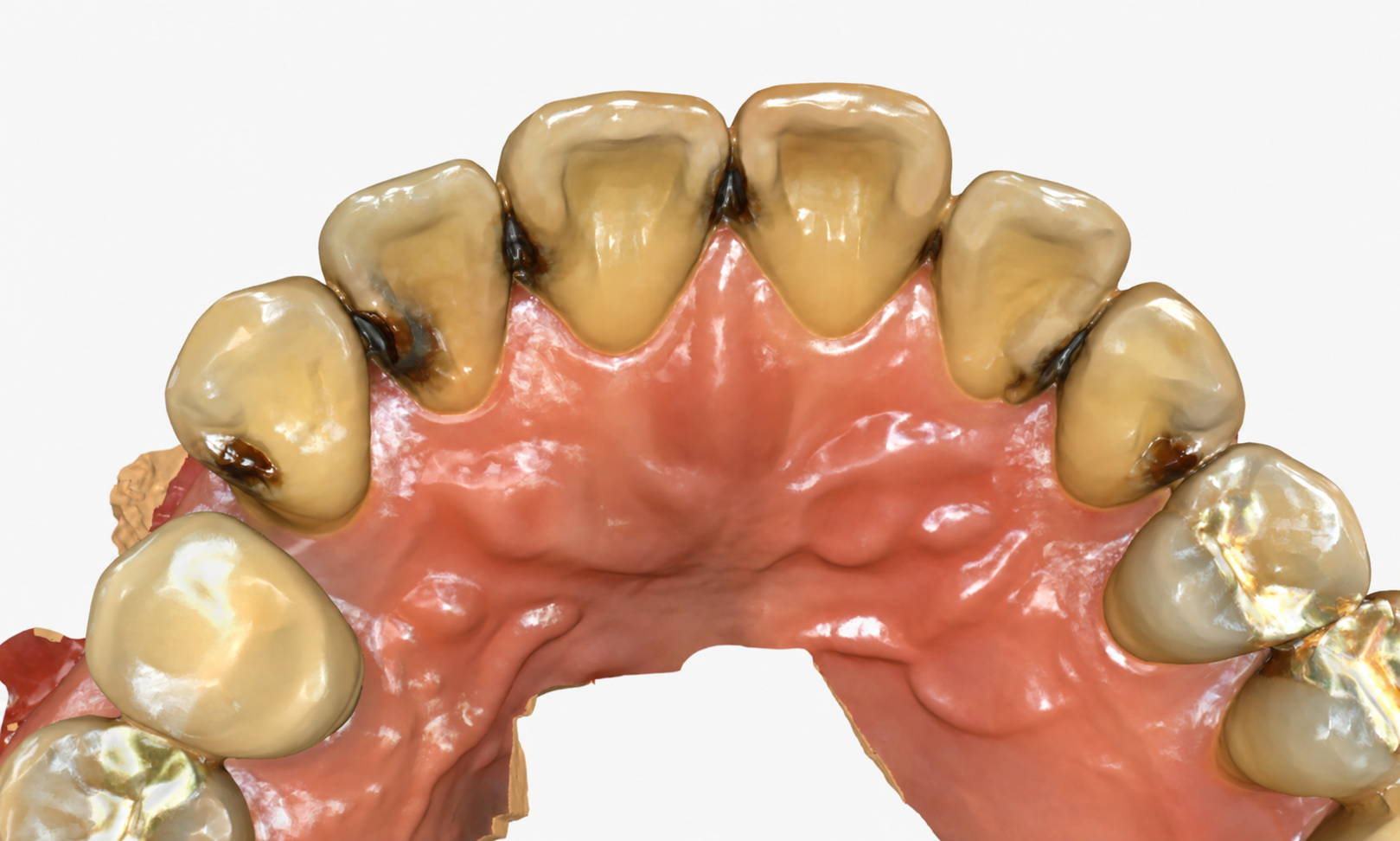
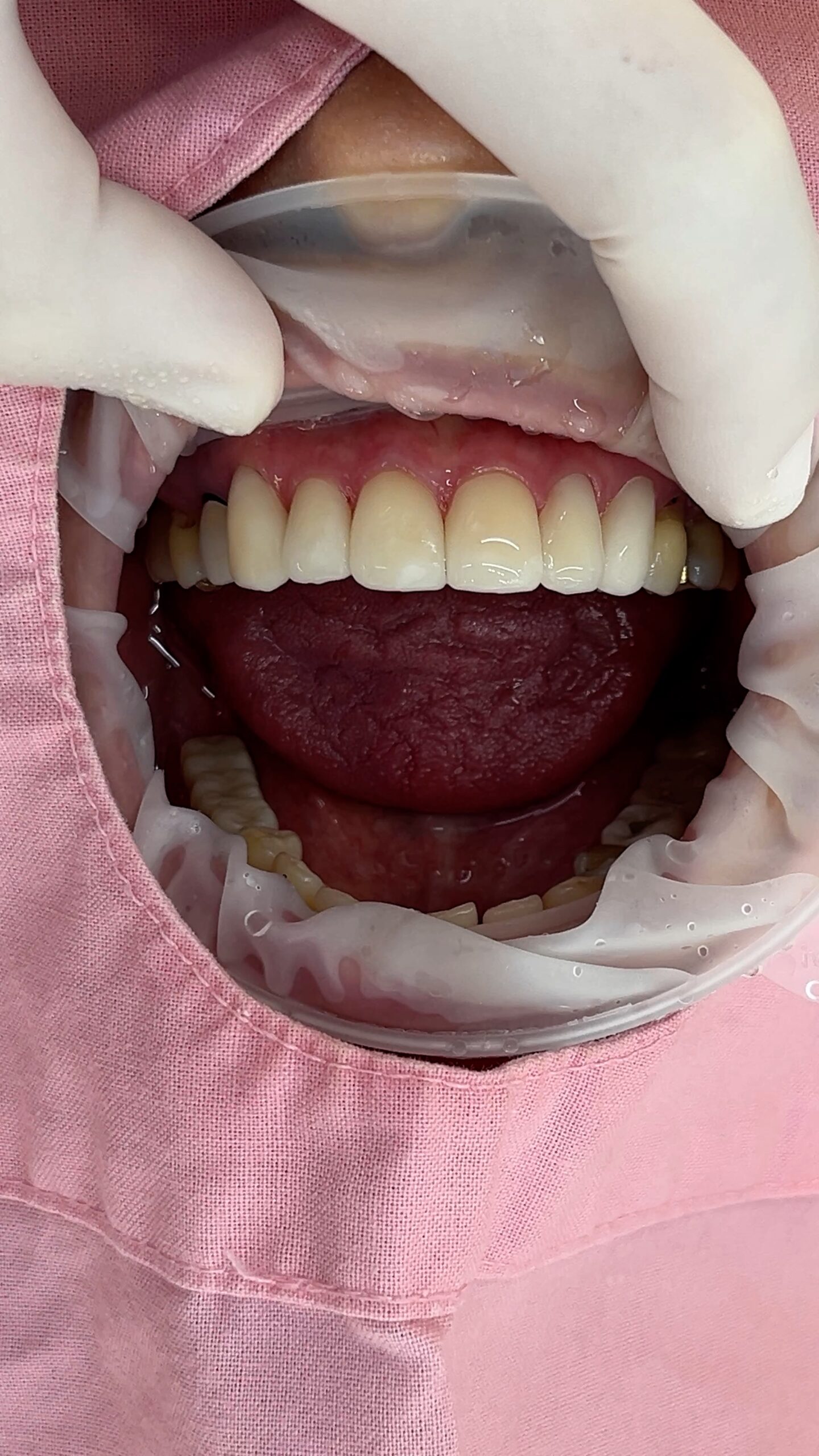
Restoration choice is not determined by photographs alone. The case article explains the process; treatment time and results vary between patients.
The approximately two hours in this case refers to the interval from completed tooth preparation to crown placement. It does not represent every patient’s manufacturing time or total treatment time. This case illustrates the process and is not a comparative study demonstrating long-term superiority of a material.
Five questions for your consultation
- How much healthy tooth will remain, and where, after removing decay and existing restorations?
- Can composite or partial ceramic provide a stable restoration?
- If a full crown is chosen, what additional preparation and benefits are involved?
- How do root canal status, cracks and bite forces affect the choice?
- How should I clean between teeth and around restoration margins afterward?
Frequently asked questions
Do three cavities in a front tooth require a full crown?
The number alone does not decide. The depth and extent of each lesion and the tissue remaining after decay removal must be assessed. Several small lesions differ from extensive multisurface damage.
Is partial ceramic weaker than a full crown?
Not always. Bonding conditions, remaining tooth structure and the bite need assessment. An anterior-restoration review found no significant survival difference between full and partial coverage, but this cannot be applied identically to every patient.
Does a full crown require more removal of healthy tooth?
Preparing a tooth for full coverage requires additional reduction. Damaged and healthy areas are distinguished, and material requirements are assessed alongside the tissue that can be preserved.
Does a crown eliminate the risk of recurrent decay?
No. Crown margins and the remaining natural tooth still need care. Interdental hygiene, diet and caries risk must be reviewed regardless of restoration type.
Can I use a study’s survival rate as my own chance of treatment success?
Not directly. Study populations, tooth conditions, materials and follow-up periods differ. Survival and complication-free success are also different concepts.
Consultation for front-tooth cavities
Tooth preservation and restoration extent are determined after examination and testing. Discuss your current tooth condition and desired shape together.
References and scope of application
- Hjerppe et al. (2023). Systematic review of survival and complications of full- and partial-coverage single-tooth anterior restorations. PubMed · Authors’ university publication record
- ESE (2021). Position statement on restoration of root-filled teeth. Full article
- Al-Meshal et al. (2025). Systematic review of remaining tooth structure and prognosis of restorations in root-canal-treated teeth. Full text on PMC
- Murphy et al. (2009). Evaluation of remaining tooth structure after full- and partial-coverage preparation in root-canal-treated teeth. PubMed
Literature checked: October 7, 2026. Sources consulted included the ESE full text, PMC material, the anterior review’s university publication record and PubMed abstracts. Research on root-canal-treated versus vital teeth and front versus back teeth is distinguished. This is general treatment information; individual plans are determined after examination.