
Front-tooth implant in one day · A clinical case from 2008
Can I have a front tooth removed, an implant placed and the final crown fitted on the same day?
In this case, a FINAL ceramic crown, not a temporary tooth, was fitted on the day of extraction and implant placement.
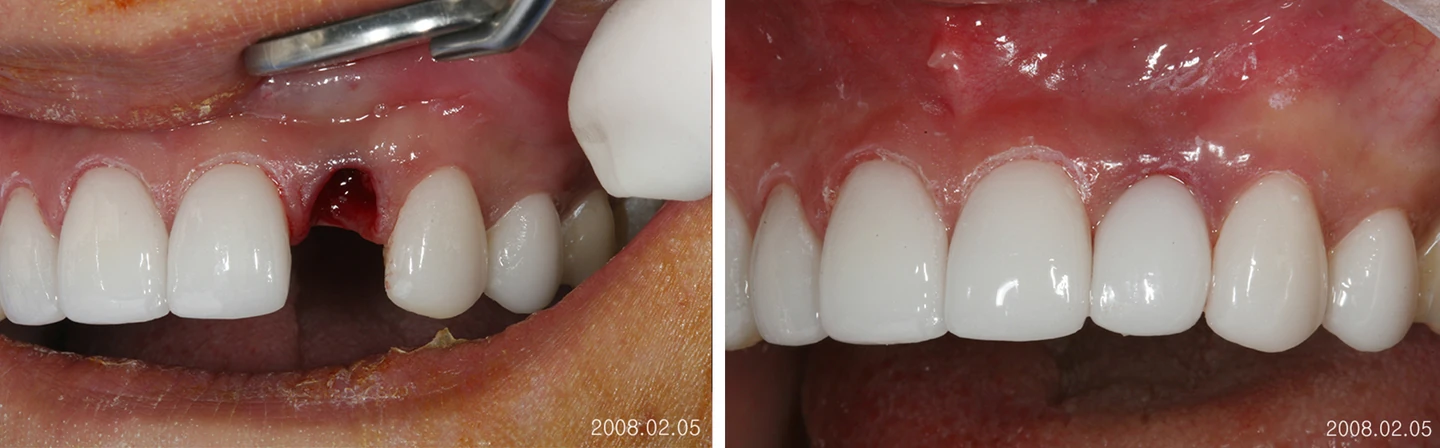
Left: immediately after extraction · Right: after the final crown
Both: 5 February 2008 · Tap the photo to enlarge.
I would like to explain a case in which I removed one front tooth, placed an implant and fitted the final ceramic crown on the same day. Bone and gum healing continued afterwards; this is an individual case, not a promise that everyone can receive a final crown in one day.
What did I check beneath the old front-tooth crowns?
This patient had previously received four connected porcelain-fused-to-metal crowns on the front teeth. Over time, the gum line had changed and a dark band at the edges of the crowns had become a concern. I examined the teeth underneath the existing restorations before planning their replacement.
The same-day front-tooth implant treatment process
These photographs document removal of the old restorations, placement of the final crown that day and the two-week review. They include the extraction site and the implant abutment.
01 · Removing the old crowns and examining the teeth
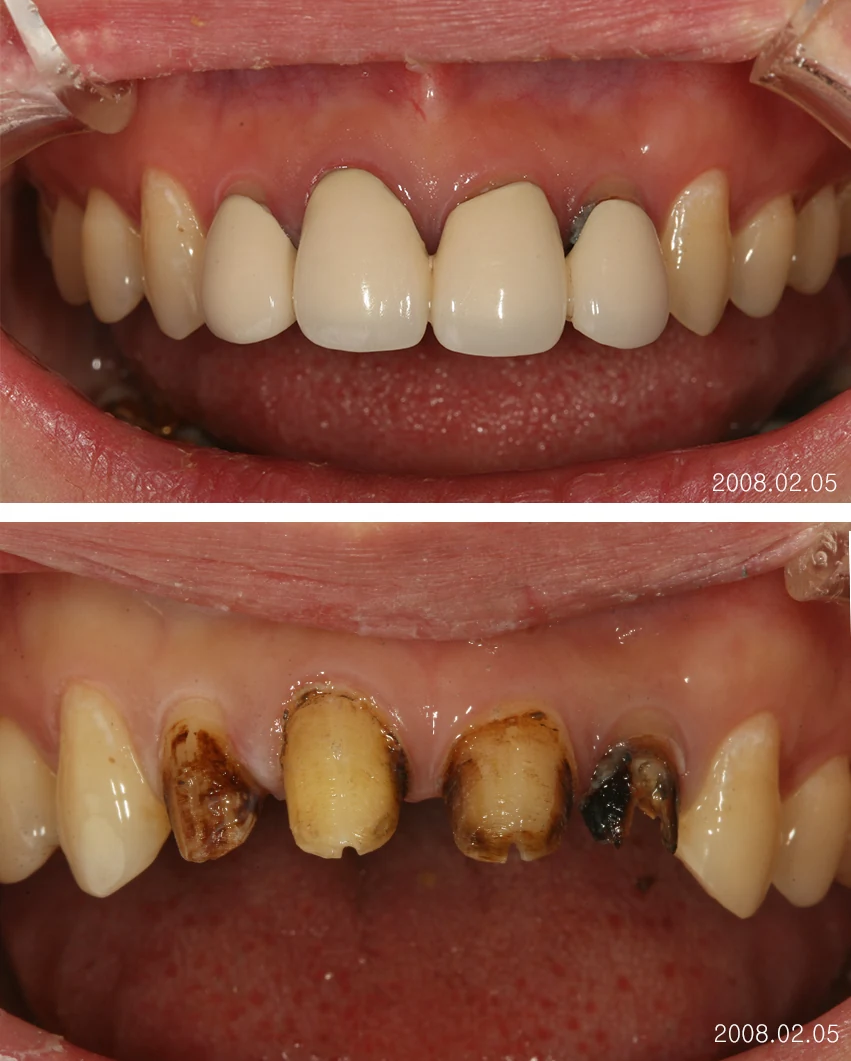
Bottom: teeth after crown removal
Both: 5 February 2008
In the upper photograph, you can see the dark band at the gum margin and the shape of the old crowns. The lower photograph shows the teeth after I removed them. There was decay underneath. One tooth had particularly extensive damage to its crown; after considering whether it could be preserved, I planned extraction and an implant.
02 · Completing the surrounding restorations before extraction
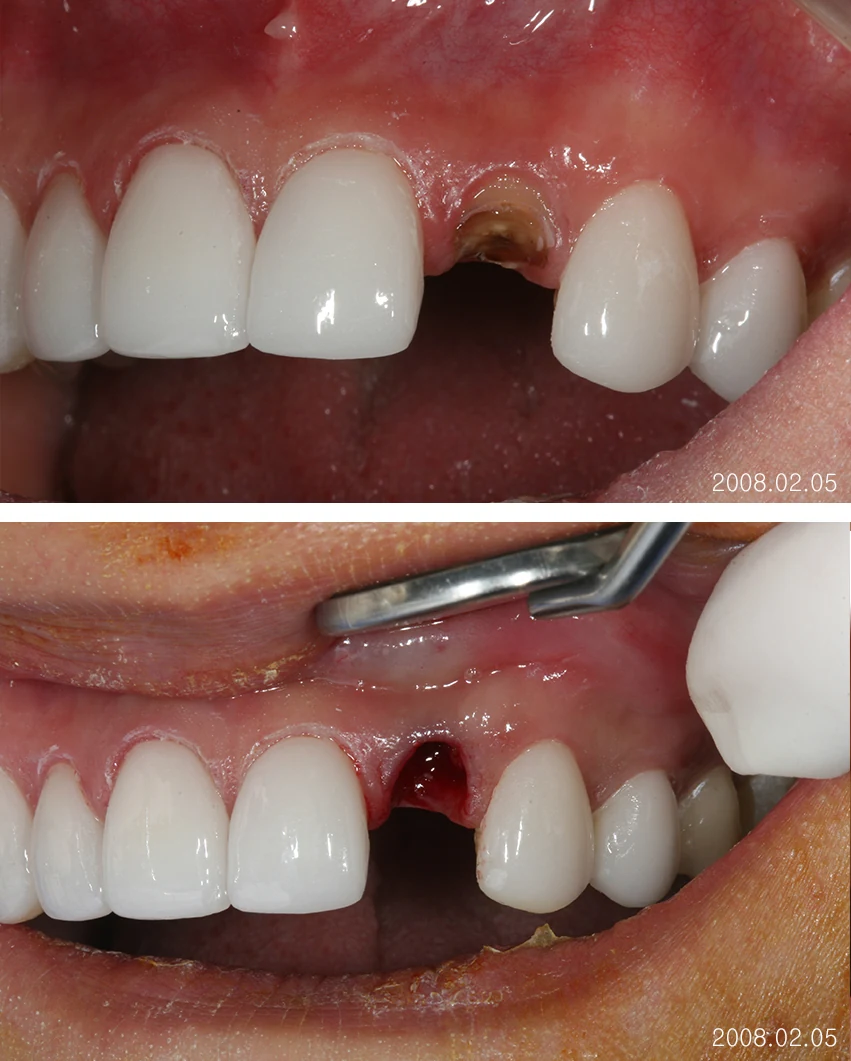
Bottom: immediately after extraction
Both: 5 February 2008
The patient wanted the teeth restored that day if possible. Before extraction and implant placement, which would cause bleeding, I made and bonded the crowns and veneers on the surrounding teeth. I then removed the tooth that had only its root remaining. This sequence depends on the condition of the teeth and the extent of treatment.
03 · Immediate implant placement and the final ceramic crown
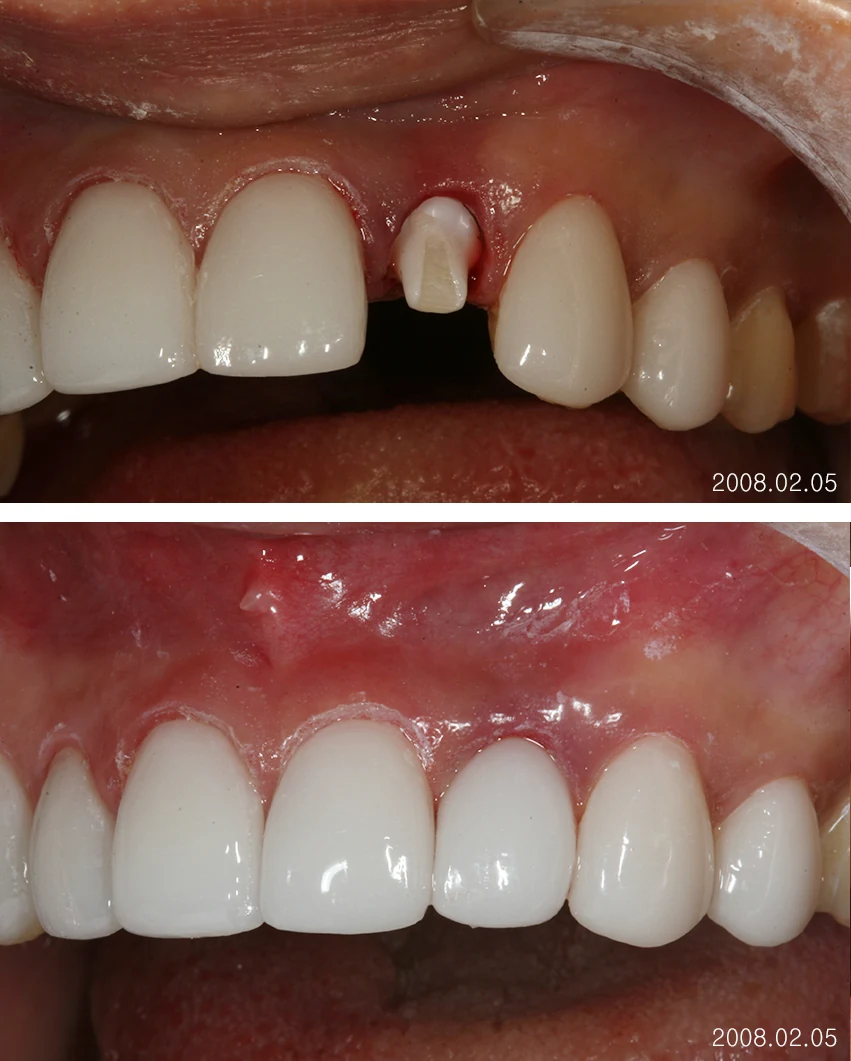
Bottom: after bonding the final ceramic crown
Both: 5 February 2008
After checking the supporting bone, I was able to place the implant through the extraction socket without making a separate gum incision. I connected a Cercon esthetic abutment from the Ankylos system, made the ceramic crown and bonded it that day. Here, “completed that day” refers to fitting the final restoration rather than a temporary tooth.
04 · Immediately after treatment and two weeks later
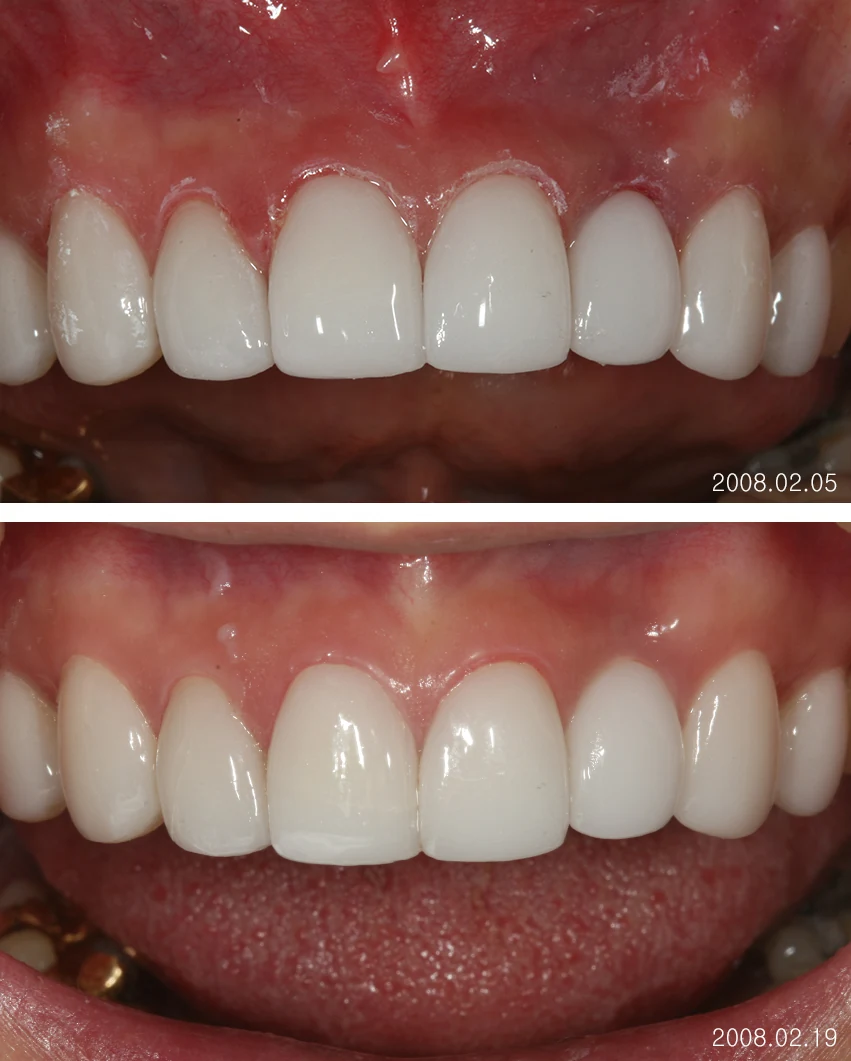
Bottom: two-week review · 19 February 2008
The upper image was taken immediately after bonding the final restorations; the lower image was taken two weeks later. The area where I reshaped the gum with a laser is visible immediately afterwards, and the gum appears healed in the two-week photograph. Although the final teeth looked complete, the implant still needed to integrate with the bone. For this patient, I advised avoiding force on the area for about two months.
05 · Upper and lower tooth colour and the bite

Bottom: two-week review · 19 February 2008
These photographs show the bite before and after treatment. Whitening the lower teeth could improve the colour match between the upper and lower teeth. The chart records that lower-tooth whitening began at the two-week visit, but I did not take photographs afterwards. The images shown here therefore represent the condition before whitening.
06 · Front-tooth shape in the smile
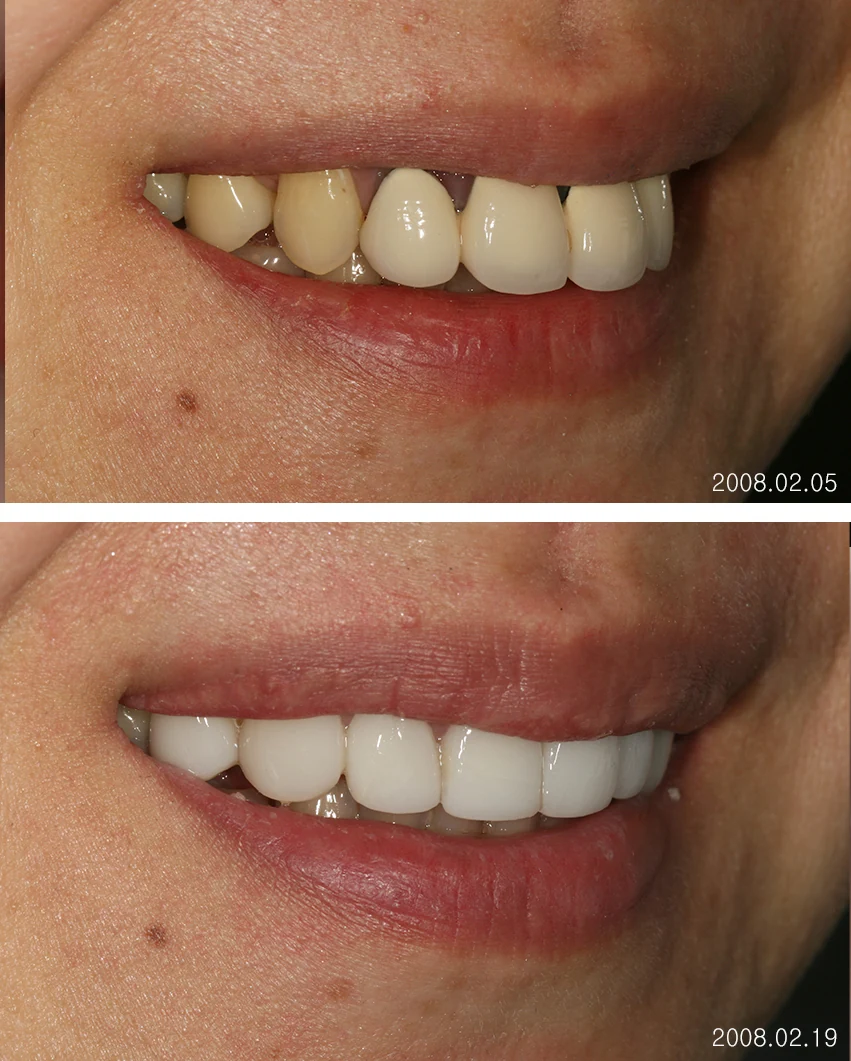
Bottom: two-week review · 19 February 2008
I also considered how the teeth looked when the patient smiled. I adjusted the prominent-looking restoration shapes in relation to the neighbouring teeth and lip line, and considered light transmission when replacing them with ceramic. This was not orthodontic tooth movement. The changes shown reflect both the implant and replacement crowns and veneers on the surrounding teeth.
What does “completed in one day” mean in this case?
On 5 February 2008, I completed extraction, implant placement, abutment connection and bonding of the final crown. I also treated the surrounding teeth with crowns and veneers.
A fixed tooth on the day of surgery does not mean that the bone and gums have finished healing, or that you can immediately bite hard foods. During early healing, avoid biting with the front teeth and excessive force, and follow the dietary, cleaning and review instructions.
Can everyone have a final front-tooth implant crown in one day?
I assess implant placement and crown connection separately
I consider the bone and gums at the extraction site, inflammation, the initial stability of the implant, its planned position and the bite. A procedure without a separate incision or with little bleeding does not, by itself, mean that a final crown can be fitted that day.
If the conditions are unsuitable, I divide treatment into stages
When bone is insufficient or the implant does not have adequate initial stability, bone grafting and healing may need to come first. Even when a final crown is not suitable immediately, a fixed temporary tooth on the implant can be an option in many front-tooth cases.
Risks and precautions for implant and restorative treatment
Extraction and implant placement can cause pain, swelling, bleeding, infection, delayed healing or failure of bone integration. Later problems can include inflammation and bone loss around the implant, gum recession, loosening or fracture of the restoration or screws, and discomfort when chewing. Further treatment may be needed.
Crown and veneer retreatment can cause sensitivity, debonding, fracture or gum irritation, and may require root canal treatment. Outcomes vary with smoking, medical conditions, tooth grinding, oral hygiene and the condition of the teeth.
Questions I am often asked before front-tooth implant treatment
Q. Does my front tooth really need to be removed? Can we check ways to save it first?
I first check whether the tooth can be saved. Even with deep decay or a fractured root, I assess the remaining tooth structure, supporting bone and possibilities for root canal treatment or retreatment before deciding on extraction. Extraction is irreversible, so I will explain why preservation may be difficult and the limitations of the alternatives.
The table below describes ten situations in which extraction may be considered. The same diagnosis can have different treatment options; the table alone cannot determine whether a tooth needs removal.
| Situation | When extraction may be considered | What I assess |
|---|---|---|
| 1. Extensive decay | Decay extends deep below the gum and a stable restoration is difficult. | Assess remaining tooth structure and whether tooth-preserving options such as crown lengthening are feasible. |
| 2. Root fracture | A fracture makes preservation of the tooth difficult. | A vertical root fracture, deep local pocket or local bone loss may be present. Not every horizontal or oblique fracture requires extraction. |
| 3. Trauma | An accident or impact causes damage that cannot reasonably be repaired. | Crown-root fracture, root fracture or displacement may occur. Repositioning, splinting and root canal treatment should be considered where appropriate. |
| 4. Periodontal disease | Severe loss of supporting bone and attachment makes retention difficult. | Consider mobility, attachment loss, prospects after periodontal treatment and ongoing hygiene. |
| 5. Persistent problems after root canal treatment | Root canal retreatment or apical surgery is unlikely to preserve the tooth. | Persistent apical lesions or recurrent infection require assessment. A failed root canal treatment does not automatically mean extraction. |
| 6. Root resorption | Extensive internal or external resorption compromises function or repair. | Check the location, extent and progression of resorption and whether treatment is possible. |
| 7. Perforation | A root or pulp-chamber floor perforation is difficult to repair and has an unfavourable prognosis. | Assess its location, size, contamination and periodontal condition. Some treatment-related perforations can be repaired. |
| 8. Repeated restorative failure | Too little sound tooth structure remains to support another restoration. | Consider root decay, cracks and an inadequate ferrule. A crown coming off alone is not a reason to extract a tooth. |
| 9. Severe tooth-position problems | Extraction is needed within an orthodontic or restorative plan after tooth-preserving options have been assessed. | Consider space, bite, root position and periodontal condition. A protruding tooth should not be replaced with an implant simply because it protrudes. |
| 10. Developmental problems | Abnormal tooth development, impaction or ankylosis makes preservation or use difficult. | Consider root-development abnormalities, ankylosis, age, growth and possible orthodontic use. |
Q. Will Dr Hanna Lee personally handle the diagnosis, surgery and final restoration?
Yes. I personally take responsibility for diagnosis and planning, implant placement, esthetic design, and fabrication and fitting of the final restoration. I continue your care from the initial assessment to the final restoration rather than passing each stage to a different dentist.
Q. Can a single upper front tooth be removed and replaced with an implant and fixed temporary tooth that day?
When I discuss a same-day fixed temporary tooth, this includes extraction of one upper front tooth. In my clinical experience, connecting a fixed temporary tooth on the day of extraction is possible in many cases. This is not a promise of the same outcome for everyone or a statement of implant success rates.
I need to assess the bone, gums, inflammation, initial implant stability and bite. I decide how to connect the temporary tooth based on both the preoperative examination and the actual condition after extraction.
Q. Could the final ceramic crown, rather than a temporary tooth, be fitted the same day?
If bone and gum conditions are favourable, and implant stability, position and the bite allow it, the final restoration may be completed that day. In this 2008 case, I bonded the final ceramic crown on the day of extraction and implant placement.
Choosing an esthetic implant program does not mean that a final crown is possible immediately in every case. If conditions are unsuitable, I fit a temporary tooth first and make the final tooth after healing. Bone and gum healing continues even after the final crown is fitted, so reviews and dietary precautions remain necessary.
Q. If a tooth cannot be connected directly to the implant, will I have to stay without a front tooth?
Not necessarily. Depending on the adjacent teeth, I may consider a fixed temporary tooth supported by those teeth. I need to check that it does not overload neighbouring teeth or press on the surgical site. If a fixed option is unsuitable, I will explain alternatives such as a removable temporary tooth.
Q. Which implant materials and restoration methods do you use for front teeth?
For the esthetic approach described here, I use an Ankylos implant from Germany with a Cercon esthetic abutment, considering the shape of both the tooth and gums. I also use screw-retained restorations on Korean implant systems, designed so that metal is not externally visible.
I previously also used restorations cemented to custom abutments. Cemented and screw-retained designs differ in shape, maintenance and repair. I do not describe one as better in every respect. I will explain the proposed components after checking implant position, gums and the bite.
Q. How do the Ankylos esthetic and basic implant program fees differ?
The clinic’s current shared fee schedule lists the Ankylos esthetic program at KRW 5,000,000 per implant, including bone grafting, and the Ankylos basic program at KRW 1,500,000 per implant. Korean implant systems have separate entries. The KRW 1,500,000 entry should not be understood as the total fee for a Korean-system front-tooth implant.
The esthetic program described here uses a Cercon abutment. I will explain the abutment and crown components for each plan, including whether temporary teeth and additional procedures are included. Crowns or veneers on adjacent teeth must be considered separately.
These are current reference fees checked on 28 October 2026, not the amount paid by this patient in 2008. Please use the fee links below for the shared schedule. I will confirm your plan and total fee after diagnosis.
Q. If I need bone grafting, how will the cost and treatment time change?
Bone grafting is included in the Ankylos esthetic program in the shared fee schedule. Where charged separately, the schedule lists simple grafting at KRW 300,000 per tooth and complex grafting at KRW 500,000 per tooth. I will explain the applicable item and what is included before surgery.
Whether grafting can be done with implant placement or must be followed by a separate healing period depends on the location and extent of the bone deficiency and whether initial stability is achievable. Healing time cannot be the same for every patient.
Q. Do you always use a CT-based surgical guide, and is there an extra fee?
I do not use a guide for every front-tooth implant. I use two guide-planning programs and apply a guide when I judge it useful after reviewing the CT and clinical condition. A guide does not replace assessment of the bone and gums, implant position or decisions during surgery.
The current shared fee schedule applies. Navigation-guided surgery is listed at KRW 100,000 per tooth. I will explain whether it is indicated and the expected total fee before treatment.
Q. Is flapless or minimally invasive surgery possible?
If the implant can be placed through the extraction socket and bone and gum conditions are suitable, I may consider an approach without a separate gum incision, as in this case. An incision may be needed to assess a bone defect, place a graft or treat the gums.
I plan surgery to assess the necessary areas and limit tissue damage rather than to fit the label “flapless.” No separate incision does not mean there is no possibility of pain, swelling or infection.
Q. Can I have a postoperative check while staying in Korea for three or four days?
Yes. If we coordinate your travel and clinic appointments in advance, you can return during your stay for a check of the bite, gums, swelling and early healing. I will plan the review with your departure date in mind.
A three- or four-day review cannot establish complete healing or long-term results. We also need to discuss suture removal if required, subsequent reviews and care after you return home. Necessary postoperative checks apply whether you live in Korea or overseas.
Q. How long does treatment take from surgery to the final tooth?
If the bone, gums and other conditions are suitable, extraction, implant placement and the final restoration may be done in one day. If an immediate final crown is unsuitable, I may plan surgery and a temporary tooth that day. For staged treatment, I connect the final restoration after assessing healing.
If sutures are used, I will separately explain when to have them removed. This is sometimes checked at around one week, but varies with surgery and wound condition. Same-day restoration or suture removal does not mean that all healing is complete.
Q. How much pain or swelling should I expect, and when can I return to everyday activities?
This depends on the extent and difficulty of surgery, grafting and your individual condition. Some people have little discomfort; others experience pain or swelling. Swelling generally subsides over time, but I cannot say that everyone has completely recovered after two weeks.
I will discuss your work and schedule and explain when to avoid strenuous exercise or activity. If swelling worsens, or you develop severe pain, fever or persistent bleeding, please contact the clinic rather than waiting for your scheduled review.
Q. What do you assess to make a front tooth and gum line look natural?
I consider colour, translucency, length and width together with the lip line and bite. Even for a single implant, its relationship to adjacent teeth and gums matters. If the gum line is not badly damaged and the bone defect is not severe, I may plan to preserve the existing form. Bone or gum treatment may be considered where necessary.
No material can guarantee a result indistinguishable from a natural tooth or a gum line that never changes. In this case, the visible changes also reflect replacement crowns and veneers on adjacent teeth.
Q. Do you have different long-term observations for Cercon esthetic implants and newer restoration methods?
I have used Ankylos and Cercon for esthetic implant treatment since 2002, including cases followed for approximately 20 years. However, observations of individual patients are not statistics guaranteeing how long every implant will last or that one program is superior.
I have used the current screw-retained front-tooth restoration approach on Korean implant systems for about two years, so I do not yet have comparable long-term observations of gum-line changes with that method. I continue to check for screw loosening and gum changes. The photographs in this article extend only to the two-week review in 2008; they are not long-term follow-up photographs.
Q. If the final tooth is fixed, can I bite food with it straight away?
Even with a fixed tooth, you should not start biting with the front teeth as usual on the day of surgery. Bone and gum healing continues. I will advise which foods are suitable and when you can use the front tooth, according to stability and the bite. Speech and chewing sensations may also feel different while you adapt to the restoration.
Q. What should I do if a temporary or final tooth loosens or comes off?
Debonding, fracture or screw loosening can occur. Please contact the clinic if the tooth moves or comes off, and do not try to stick it back with household glue. I will assess fixation, the bite and surrounding tissues before deciding what is needed.
Q. How often will I need maintenance after treatment?
I check healing and the restoration after surgery. Later review intervals depend on gum condition, hygiene, smoking, medical conditions, tooth grinding and the bite. Regular examinations, brushing and interdental cleaning are needed. Even if the implant remains in place, inflammation or restoration problems may require additional treatment, repair or replacement.
Q. Can photographs and a CT scan tell you in advance whether same-day treatment is possible?
Front-tooth photographs and CT cross-sections help me assess bone shape and surrounding structures and discuss a possible plan. A section along the length of the affected tooth is particularly useful. However, photographs and a CT alone cannot confirm the final schedule. I need to examine you, assess the gums and bite, and check stability after extraction.
Q. What should I tell you if I am worried about having a front tooth removed?
I want to understand what concerns you most, as well as the examination findings. Please feel free to raise worries such as those below. These are general examples for discussion, not quotations from this patient.
I worry that it will show when I smile
Let us look at the gum line, tooth length, symmetry and dark spaces between teeth as well as colour. We can discuss the appearance you want and what treatment can achieve.
I cannot manage work or appointments without a front tooth
Tell me about work and important dates. I will plan temporary teeth and appointments while allowing the healing that treatment needs.
I worry that the gum will recede later
I will distinguish the appearance of the restoration now from later changes, and explain gum changes, maintenance and the reasons for regular reviews.
Could we be removing a tooth that can still be saved?
Please ask why extraction is recommended and whether preservation is possible. I will explain the findings, alternatives and limitations before we decide on a plan together.
How much does this treatment cost?
Fees vary with materials, the extent of treatment and tooth condition. I will explain the treatment plan and total fee after diagnosis.
This case included one front-tooth implant as well as replacement crowns and veneers on neighbouring teeth. Please distinguish the reference fee for each treatment from the total for a combined plan.
Implant reference fees →Implant reference fees →
Veneer and crown reference fees →Veneer and crown reference fees →
These links open the clinic’s shared fee schedule in Korean. It shows current reference fees, not the amount paid by this patient.
Related information and appointments
About implant treatment at Harue Dental Clinic

