
Restoring occlusal vertical dimension after molar loss: changes in facial appearance
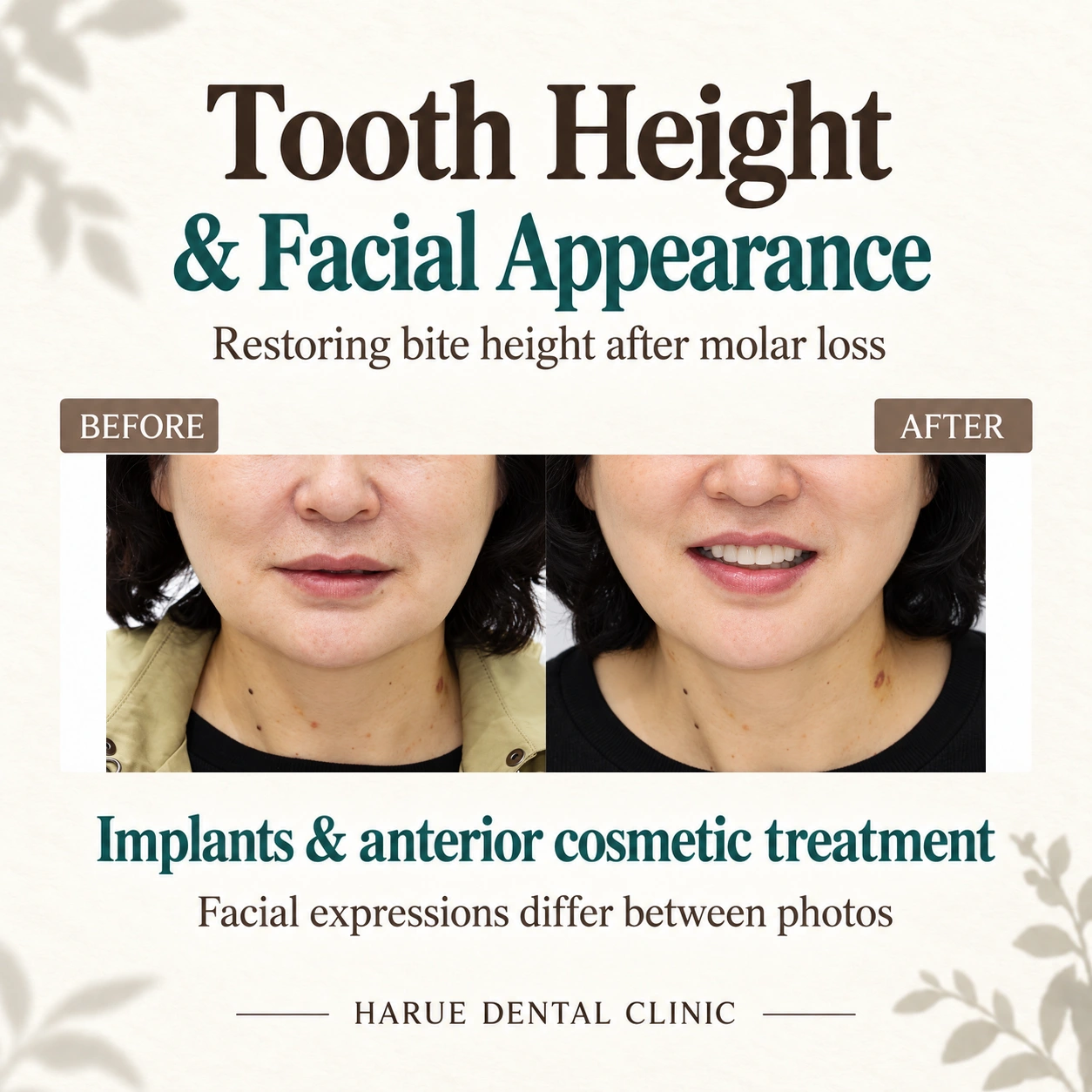
CASE SUMMARY · Restoring occlusal vertical dimension
This case at a glance
A patient who had been living with missing molars.
The dentist observed a shorter-looking lower face, noticeable wrinkles around the mouth and an older-looking appearance.
Molar height was re-established and the occlusal vertical dimension was restored.
This case combined implant treatment with cosmetic treatment of the front teeth.
Changes in the appearance of the lips, mouth corners, lower face and smile.
The dentist’s record states that both photographs were taken on the same day.
The original photographs and the annotated vertical-dimension photographs are compared together.
The patient’s lips are closed in the before photograph and the patient is smiling in the after photograph. Facial expression can affect the mouth corners, wrinkles and lip shape.
Clinical case provided by Harue Dental Clinic: Dr. Hanna Lee
An implant and anterior cosmetic treatment case considering both tooth height and the lower face
When a patient has lived with missing molars for a long time, assessment should consider not only the spaces left by the missing teeth but also the height at which the upper and lower teeth meet during chewing and the appearance of the lower face. This patient had been living with missing molars. Before treatment, the dentist observed a shorter-looking lower face, more prominent wrinkles and an older-looking appearance.
At Harue Dental Clinic, molar height and the occlusal vertical dimension were restored alongside cosmetic treatment of the front teeth. The dentist described a younger-looking, slimmer appearance and a lifting-like change after treatment. This article preserves those clinical observations while distinguishing what is visible in the photographs from causes that cannot be determined from photographs alone.
Can restoring tooth height change facial appearance?
Changes in the occlusal vertical dimension can affect the shape of the lower face and the tissues around the lips. However, facial appearance also depends on expression and photographic conditions. Restoring the occlusal vertical dimension cannot be said to produce the same appearance changes in everyone. View the 3D study
The expressions differ in these before-and-after photographs
The lips are closed before treatment, whereas the patient is smiling after treatment. These two photographs alone cannot distinguish whether changes in mouth-corner position or wrinkles are due to an increased vertical dimension or to a different expression.
To assess actual soft-tissue changes associated with an increased vertical dimension, it is preferable to compare before-and-after photographs with the lips gently closed in a relaxed position. Camera angle, distance, magnification and head position should also be matched as closely as possible.
The dentist’s clinical reasoning · Molar height and overall facial harmony
The key clinical consideration in this case was to view replacing missing molars and restoring the vertical dimension together. The dentist described an overall restoration that considered the relationship between molar height and the lower face, in addition to cosmetic treatment of the front teeth.
In the pretreatment appearance of a patient who had left missing molars untreated, the lower face appeared shorter, with more wrinkles and an older-looking appearance. After treatment re-established molar height and restored the vertical dimension overall, the patient appeared much younger and slimmer, with a lifting-like effect visible.
For patients who have lost molars or whose vertical dimension has decreased because of tooth wear, appropriate adjustment of the vertical dimension can therefore improve facial form and create a younger-looking, rejuvenation-like appearance.
This patient underwent implant treatment together with cosmetic treatment of the front teeth. The photographs of this case were taken on the same day. Such overall restoration can offer changes beyond those of dental treatment alone.
Restoring vertical dimension and a lifting-like change in appearance
The original description uses “lifting effect” and “rejuvenation effect” to describe the clinical impression of a younger-looking, slimmer appearance after treatment. These photographs do not demonstrate reversal of skin aging itself or an effect equivalent to a cosmetic lifting procedure.
The clinical decision to restore missing teeth and vertical dimension is described alongside the changes in appearance visible in the photographs, without treating the two as the same finding.
Actual before and after · Lower face and smile
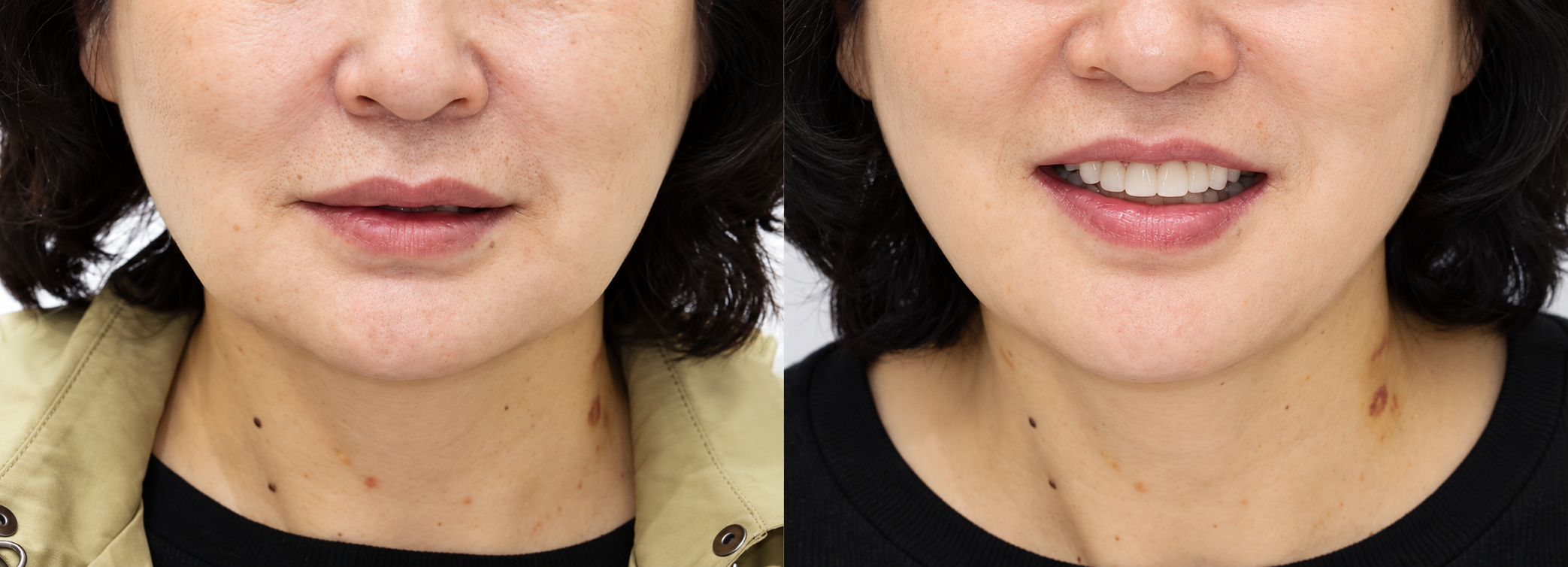
01. Assessing the lower face after molar loss
The patient had been living with missing molars. The dentist observed that the lower face appeared shorter before treatment, with more wrinkles and an older-looking appearance.
The important issue was not just the spaces left by missing teeth, but the relationship between molar height and the lower face. “Occlusal vertical dimension” refers to the vertical relationship between the upper and lower jaws when the teeth are in contact.
Considering tooth height together with the lower face
This case examines how facial appearance seemed to change after molar height was re-established and the vertical dimension restored.
The impression given by a photograph and an actual vertical-dimension measurement are different kinds of evidence.
Annotated photographs · The area being observed
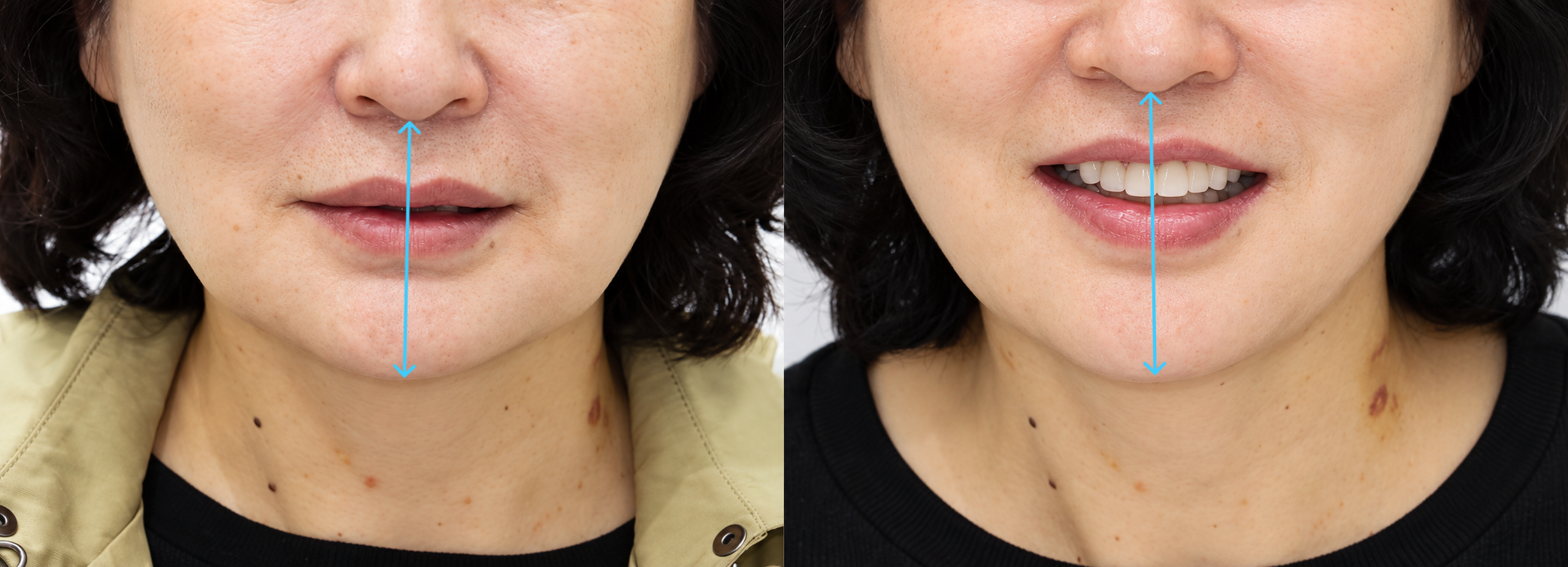
02. Combining implants with cosmetic treatment of the front teeth
The patient underwent implant treatment together with cosmetic treatment of the front teeth. The dentist explained that molar height was re-established and the vertical dimension restored overall.
Because both molar height and the appearance of the visible front teeth changed in this case, it is difficult to attribute changes in the smiling appearance to only one treatment.
The original description also explains that appropriate vertical-dimension adjustment may be considered for patients whose vertical dimension has decreased because of tooth wear. This describes a general group for clinical consideration; it does not add a diagnosis of tooth wear in this patient.
Same-day photography and treatment duration are different facts
The dentist’s record states that the photographs of this case were taken on the same day.
The overall implant treatment duration or detailed treatment sequence cannot be determined from the photography date alone.
03. Four changes observable in the photographs
The following differences can be observed in the original photographs. These are descriptions of photographic appearance, not measurements of the isolated effect of restoring the vertical dimension.
After treatment, the lips part, changing the shape of the upper and lower lips; the area around the mouth appears fuller.
Around the mouth corners
The mouth corners appear higher than before treatment, and the drooping impression around the mouth seems less pronounced.
Lower face
The relationship between the chin and the lips looks different, giving the lower face a more natural-looking appearance.
Overall impression
The smile visible after treatment gives a brighter, younger-looking impression.
Because a closed-lip photograph is being compared with a smiling photograph, the influence of expression must also be considered.
04. Distinguishing observed appearance from further assessment
What can be confirmed is that the lip shape, mouth corners, lower face and smiling appearance look different in this patient’s before-and-after photographs. The dentist described a younger-looking, slimmer appearance and a lifting-like change after treatment.
However, these photographs alone cannot quantify the actual increase in vertical dimension, changes in wrinkle depth, the duration of the changes or the proportion attributable to restoring the vertical dimension. The patient’s satisfaction and long-term treatment outcome are not inferred.
Photographs with matching expressions and conditions help further assessment
Comparing photographs with the lips gently closed in a relaxed position before and after treatment helps reduce differences in expression when assessing soft-tissue changes.
Clinical observations should not be exaggerated as if they were objective measurement results.
View the before-and-after photograph included in the original Word document
Research evidence · Vertical dimension and facial form
Mohindra and Bulman’s 2002 study
Questionnaires were sent to 96 patients who had received treatment that increased their occlusal vertical dimension; the response rate was 72%. Of the respondents, 79.7% reported looking younger after treatment. A panel of five independent assessors judged 81.2% of the patients in the reviewed photographs to look younger. Original paper and abstract
These percentages describe appearance assessments in that study group. They are not treatment success rates for all patients undergoing vertical-dimension restoration, nor do they quantify how much younger this patient appeared.
Kim and colleagues’ 2025 3D facial-scan study
The study compared increases of 2, 4, 6 and 8 mm in 40 participants with healthy dentitions and no loss of vertical dimension. Soft-tissue measurements changed: total facial height, lower facial height and the nasolabial angle increased, while lip width and height decreased. View the Wiley paper
This research shows that changes in vertical dimension can affect facial form. However, the participants differ from this patient, whose vertical dimension was restored after molar loss, and the study’s tested values cannot be assigned as this patient’s vertical-dimension increase.
A higher vertical dimension is not always more attractive
Sun and colleagues’ 2021 study compared facial form and esthetic ratings after stepwise increases in vertical dimension in 25 participants with no vertical-dimension loss. Under those conditions, the original vertical dimension was often rated as more esthetic. View the study
Clinical judgment should focus on appropriately restoring the vertical dimension that is needed, rather than increasing it indiscriminately to change appearance.
Five-point checklist before a vertical-dimension consultation
List which molars have been missing, since when, and what treatment you have received afterward.
Explain whether your teeth seem shorter or worn and what discomfort you experience when chewing.
Discuss your goals for restoring the molars separately from your preferences for front-tooth shape and the teeth visible when smiling.
Check whether relaxed, gently closed-lip photographs and smile photographs can each be compared under matching conditions.
Distinguish changes visible in photographs from findings that need examination, and discuss maintenance and follow-up plans.
Occlusal vertical-dimension restoration FAQ
Can restoring the vertical dimension alone make the face look younger?
Facial appearance may change, but a younger-looking result cannot be guaranteed for everyone.
Changes in vertical dimension can affect the lower face and the tissues around the lips. Because the expressions also differ in this case, the isolated effect of vertical-dimension restoration cannot readily be separated from the influence of expression.
What treatment did this patient receive?
The patient received implant treatment together with cosmetic treatment of the front teeth.
The dentist explained that molar height and the vertical dimension were restored. No unprovided materials, implant counts or values for the increase in vertical dimension have been added.
Do the blue arrows measure actual facial length?
No. They are explanatory markers showing the area being observed from beneath the nose to the chin.
The photographs lack a calibrated measurement reference and matching expressions, so the increase in vertical dimension cannot be calculated from arrow length alone.
If both photographs were taken on the same day, was treatment completed in one day?
The photography date alone does not establish that the entire treatment was completed in one day.
The dentist’s record states that the photographs were taken on the same day, but overall implant treatment duration and photography timing are different pieces of information.
Are the paper’s 79.7% and 81.2% treatment success rates?
No. They are the proportions rated as looking younger in that study.
The 79.7% figure reflects respondents’ self-assessment; 81.2% reflects independent assessors’ evaluation of the photographs. They cannot be used as functional success rates or to predict an individual’s treatment effect.
What photographs are needed to compare facial changes?
It is preferable to compare before-and-after photographs taken under matching conditions with the lips gently closed in a relaxed position.
Smile photographs should be compared separately. Matching camera angle, distance, magnification and head position as closely as possible helps reduce the effects of expression and photographic conditions.
Understanding dental restoration alongside facial harmony
Re-establishing molar height and appropriately restoring the vertical dimension can provide an opportunity to assess lower-face and smile harmony beyond simply filling missing-tooth spaces. This case, as described by the dentist, documents overall restoration combining implants and cosmetic treatment of the front teeth.
At the same time, a change in photographic appearance must be distinguished from the isolated effect of vertical-dimension restoration. Treatment methods, the required vertical dimension and visible facial changes vary with each person’s oral condition, expression and treatment circumstances.
References
- Mohindra NK, Bulman JS. The effect of increasing vertical dimension of occlusion on facial aesthetics. British Dental Journal. 2002;192(3):164–168. DOI: 10.1038/sj.bdj.4801324.
- Kim SW, Ko KH, Huh YH, Cho LR, Park CJ. Evaluation of Perceptual and Anthropometrical Facial Changes According to Increase in Vertical Dimension of Occlusion. Journal of Oral Rehabilitation. 2025;52(6):833–839. DOI: 10.1111/joor.13937.
- Sun J, Lin YC, Lee JD, Lee SJ. Effect of increasing occlusal vertical dimension on lower facial form and perceived facial esthetics: A digital evaluation. Journal of Prosthetic Dentistry. 2021;126(4):546–552. DOI: 10.1016/j.prosdent.2020.07.013.