

01. Initial condition and implant plan
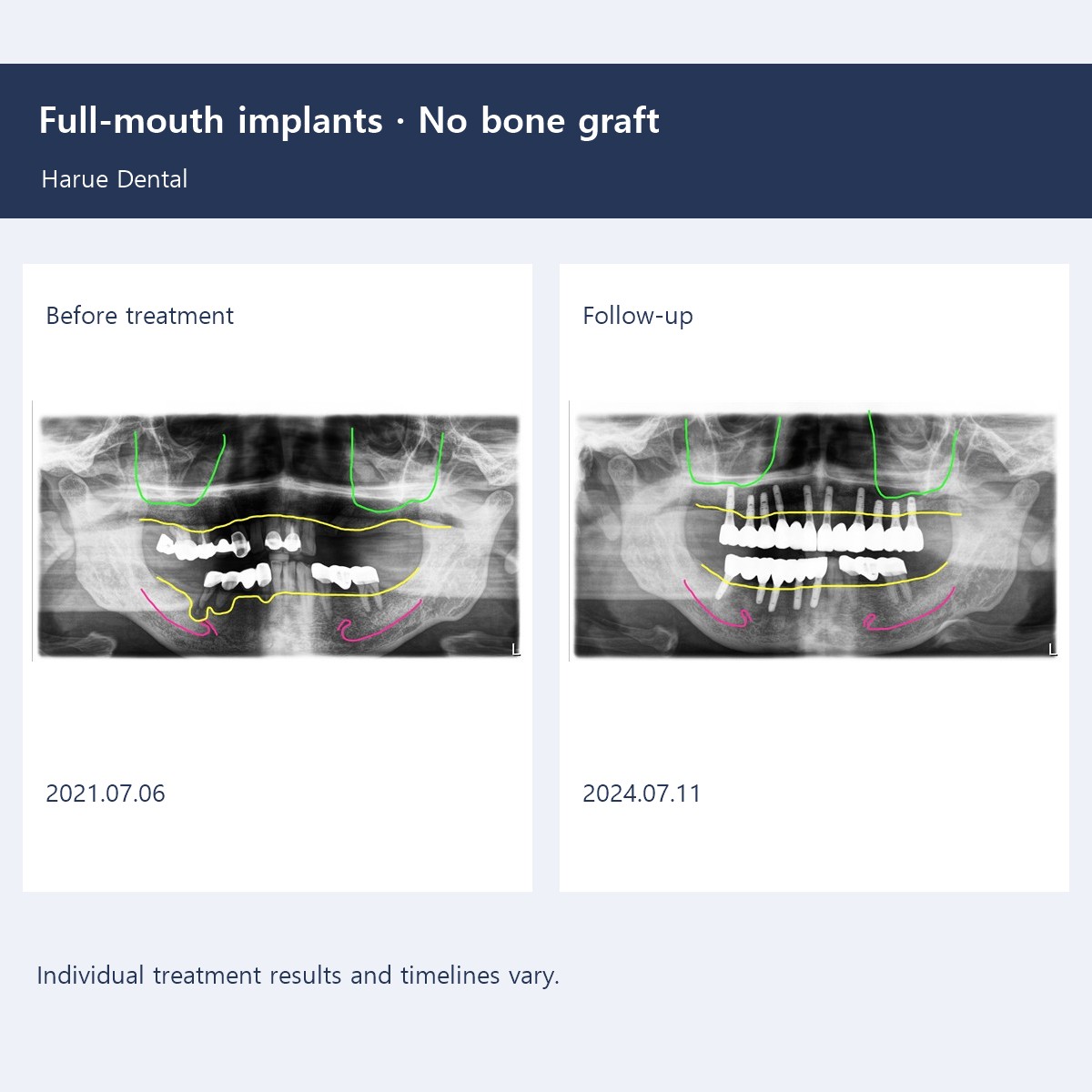
Several upper-left teeth were missing. The patient had relied on the right side for chewing, then developed difficulty there too. Panoramic imaging showed bone loss around the remaining upper teeth and severe inflammation and bone loss near the lower-right premolars.
An inflamed area close to the nerve
The original image description records inflammation extending near the mandibular nerve. The plan avoided forcing implant placement in that area.
The red and yellow lines in the comparison images indicate the nerve and the extent of inflammation, respectively.


02. Ten upper implants and same-day temporary teeth
The patient wanted the upper teeth treated first, so full-arch upper implant surgery was performed first.
Ten upper implants placed
Ten upper implants were placed and abutments connected.
Temporary teeth on surgery day
Upper temporary teeth were made and fitted on the surgery day. Final restorations followed after healing.
The photograph below shows abutments connected to the upper implants.


03. Lower-jaw surgery a month later
The lower jaw was operated on one month after the upper jaw. The patient did not want a toothless interval, so implants were placed at extraction.
Avoiding the severely inflamed site
No implant was placed at the second-premolar site with severe inflammation and bone loss. At the first-premolar site, remaining lingual bone was used. Grafting was unnecessary in this individual case.
Same-day lower temporary teeth
Lower temporary teeth were made on the day of surgery. The original record describes adjusting the bite so that they did not quite contact the upper teeth.
Extraction and placement sequences and bite adjustments depend on the patient's condition and treatment plan.


04. Scanning and restoration fabrication three months after lower surgery
At three months after lower surgery, scan bodies were used to record implant positions.
Designing abutments and zirconia restorations
The scan data guided abutment and zirconia design. Scan bodies and abutment design materials are shown below.


05. Final restorations and follow-up
At the patient's request, upper and lower surgery were separated by one month, then treatment was completed with final restorations.
How the treatment interval is measured
Four months after the first, upper-jaw surgery, or three months after the second, lower-jaw surgery. The original record does not specify the complete interval from the first consultation or total appointment count.
Restoration at the site without an implant
The area where severe inflammation precluded an implant was restored with a connected artificial tooth.
Approximately four-year follow-up described in the original article
At original publication, roughly four years had passed and regular examinations were recorded. The attached gum condition was described as relatively favorable, with maintenance not particularly difficult.
This is not a newly confirmed current examination. The surgery, duration and outcome vary with individual conditions.