
HARUE DENTAL · FULL-MOUTH IMPLANTS
When many teeth have been lost and the remaining teeth have tilted, I look beyond filling each gap. I assess which teeth can be maintained, the available bone and the shape of the final teeth, including how the patient will clean them.
Treatment and explanation: Dr Hanna Lee
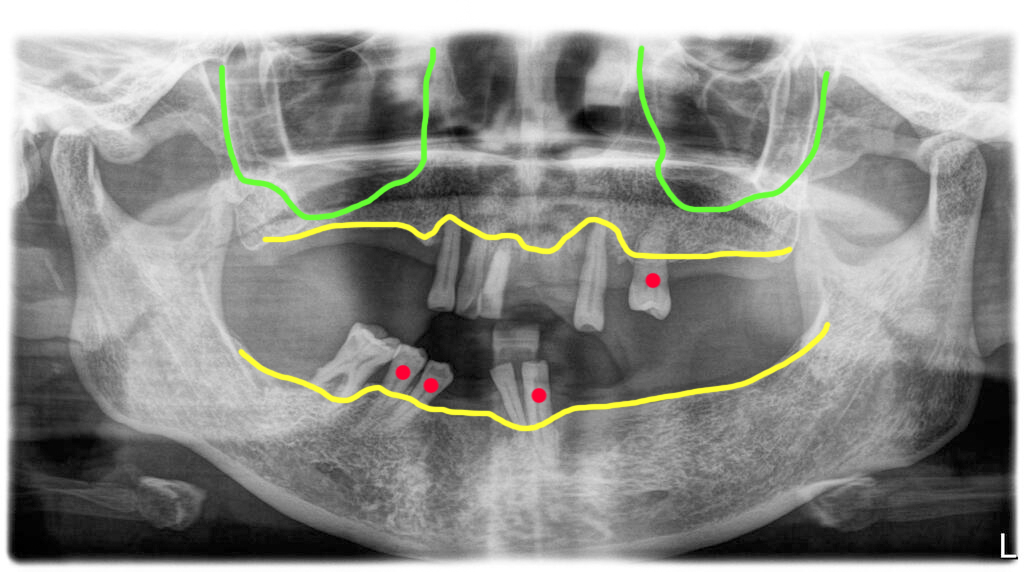
Photographed: 2021.07.05
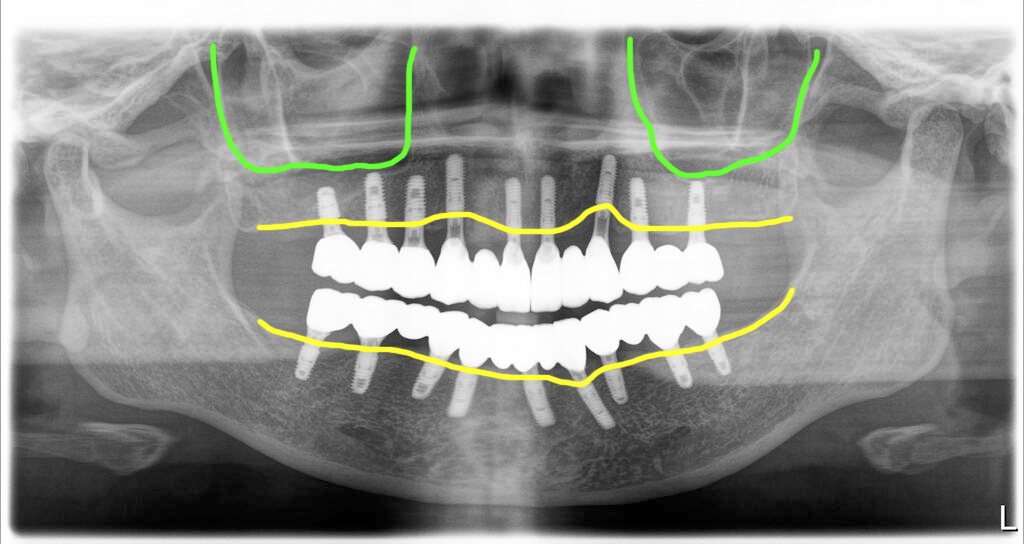
Photographed: 2023.10.17
Case overview
- Periodontitis, multiple missing teeth and tilted remaining teeth
- Right lateral-window sinus graft; same-day temporary teeth supported by stable implants
- About six months and five visits; custom abutments and zirconia restorations
01 · Assessing the remaining teeth
This patient had advanced gum disease and had already lost many teeth. The remaining teeth had tilted toward the spaces. Most upper teeth had terminal periodontitis. The upper tooth marked in red had less advanced disease and did not require immediate extraction solely because of its periodontal stage.
I nevertheless recommended extraction after considering its position, the difficulty of cleaning it and the risk of future inflammation affecting the surrounding implant treatment. A healthy, well-positioned tooth that can be kept clean may be retained; this was an individual decision, not a rule to remove every remaining tooth.
The lower teeth marked in red also had periodontal disease and unfavourable positions. Their tilting made a maintainable full-mouth restoration difficult. After assessing these factors, I planned extraction of the remaining teeth and implant rehabilitation.
Photographed: 2021.07.05
02 · Grafting, placement and same-day temporary teeth
After extraction, I placed the implants. There was very little bone in the upper right posterior region, so I performed a lateral-window sinus graft during placement.
The implants in the grafted sinus region did not have sufficient initial stability. I left them submerged without attaching abutments. The other stable implants supported abutments and temporary teeth on the same day. Same-day temporary teeth do not mean that bone healing is complete.
Sites with substantial bone loss required a different placement level and restoration plan. This is why I recommend assessing periodontal disease before severe bone loss develops, while considering whether teeth can still be preserved.
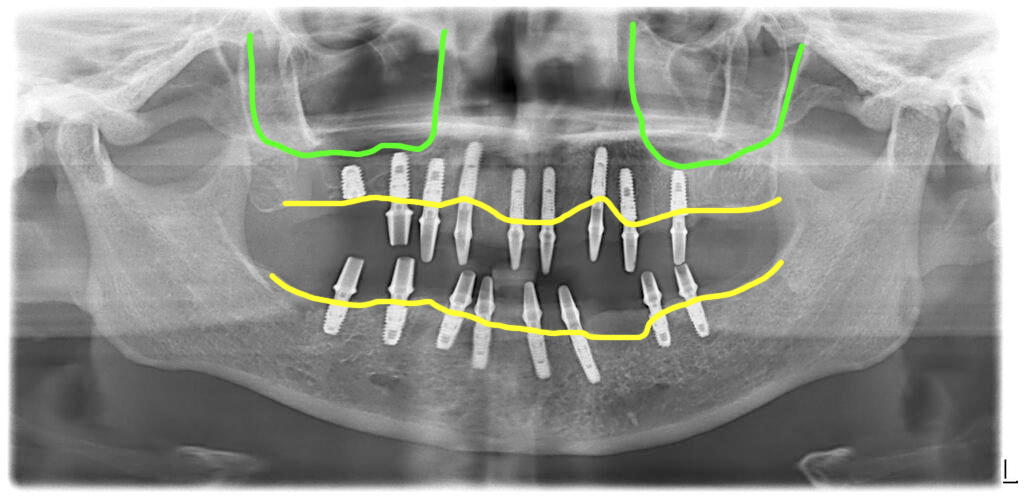
Photographed: 2021.08.03
03 · Additional placement and final restorations
I later placed one additional implant in the lower left region, where severe inflammation had prevented placement at the first operation. The total number of visits was five.
Because initial stability in the upper right sinus-graft region was insufficient, I allowed about six months before the scan-body scan. I then completed the custom abutments and zirconia restorations, with spaces designed to allow interdental-brush cleaning.
The final panoramic image shown here was taken at follow-up on 17 October 2023. It is a follow-up record, not the date on which treatment was completed.
Photographed: 2023.10.17
Frequently asked questions
Can one or two remaining teeth be kept?
I assess their position, periodontal support, mobility and whether they can be cleaned and restored. A maintainable natural tooth may be retained. If severe mobility or an unfavourable position compromises the overall plan, extraction may be considered. Full-mouth treatment does not automatically require removing every tooth.
Can a sinus graft and implants be done together?
They can be combined when the infection, available bone and sinus conditions allow adequate treatment. Severe infection, very soft bone or a sinus problem may require a staged approach and a healing interval, sometimes around two to six months depending on the findings. Shortening the schedule should not take priority over stability and healing.
Why does the number and distribution of implants matter?
An appropriate number and distribution can support shorter, maintainable restoration sections and help distribute load. Too few implants with long spans can increase mechanical and repair demands. More implants are not always better: bone, bite, prosthetic structure and hygiene must be considered together.