
The treatment process and points to discuss about fees
CASE SUMMARY · Full-mouth implants
This case at a glance
Patient and main concerns
Man in his 60s
Upper complete denture, lower bridge and partial denture
Worsening lower gums and loose teeth
Staged surgery and temporary teeth
Eleven lower implants placed first
Lower temporary teeth fitted on surgery day
Upper surgery five months after lower surgery
Final restorations and follow-up
Completed with crowns and bridges in both jaws
Original record: six years of use and regular reviews
Digital guide used for a narrow lower jaw
In this case, lower and upper surgery took place at different times. Five months is the interval between surgeries, not the full treatment duration. Six years refers to the original article's record.
Treatment and content review: Dr. Hanna Lee
01. Initial condition and plan
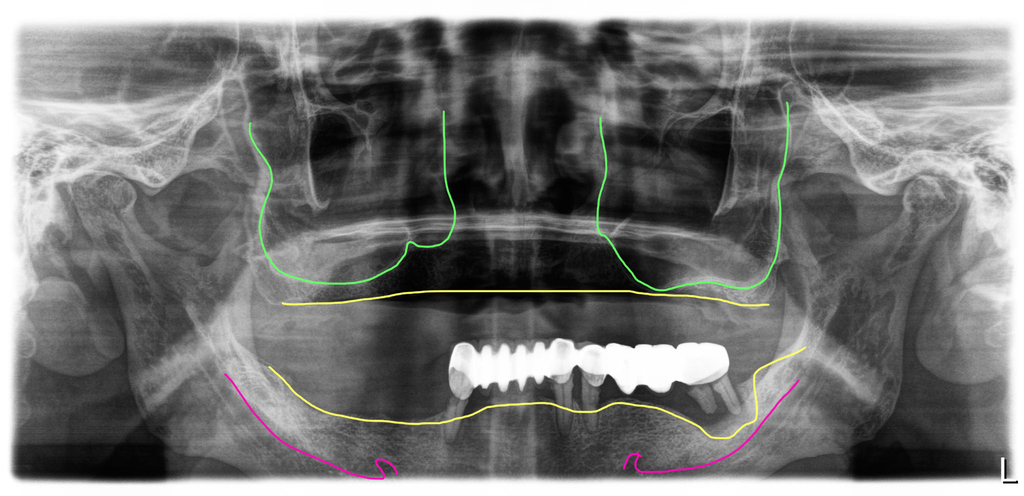
A man in his 60s had long used an upper complete denture and a lower bridge with a partial denture. Worsening gums and marked mobility around the lower bridge prompted treatment.
Discomfort and treatment order
Because the lower jaw was particularly uncomfortable, the lower jaw was treated first while the upper complete denture remained in use.
Planning considerations
The narrow width of the lower jaw required careful positioning. A digital surgical guide was used.
02. Lower surgery and same-day temporary teeth
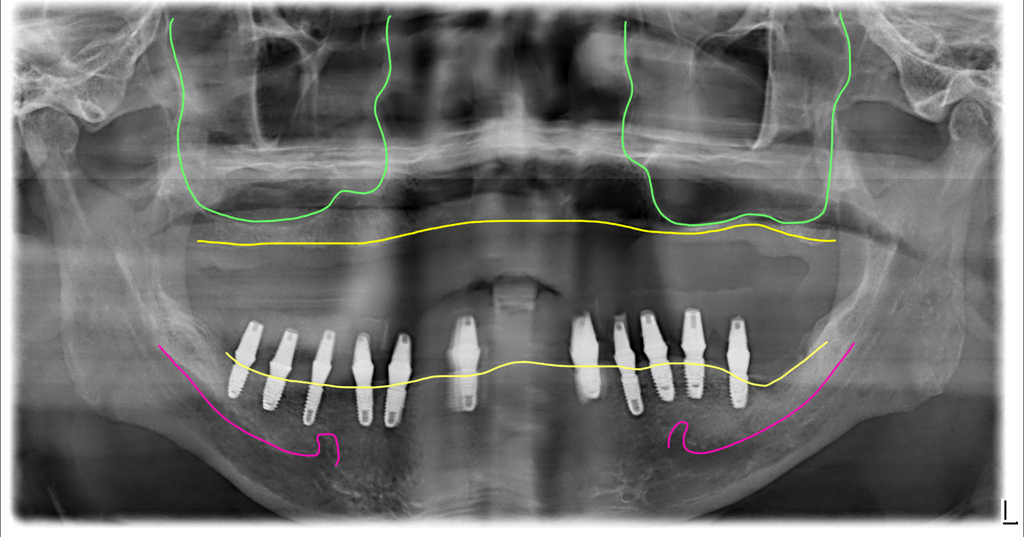
The lower bridge and remaining teeth were removed and implants placed at extraction.
Eleven lower implants
Eleven implants were placed and abutments connected.
Temporary teeth on surgery day
Temporary teeth were fabricated and fitted that day. These were temporary teeth, not the final restorations.
03. Upper surgery five months after lower surgery
Five months after lower surgery, while preparing the lower restorations, the tilt of the existing upper denture and the balance between the jaws were reviewed.
Decision to add full-arch upper implants
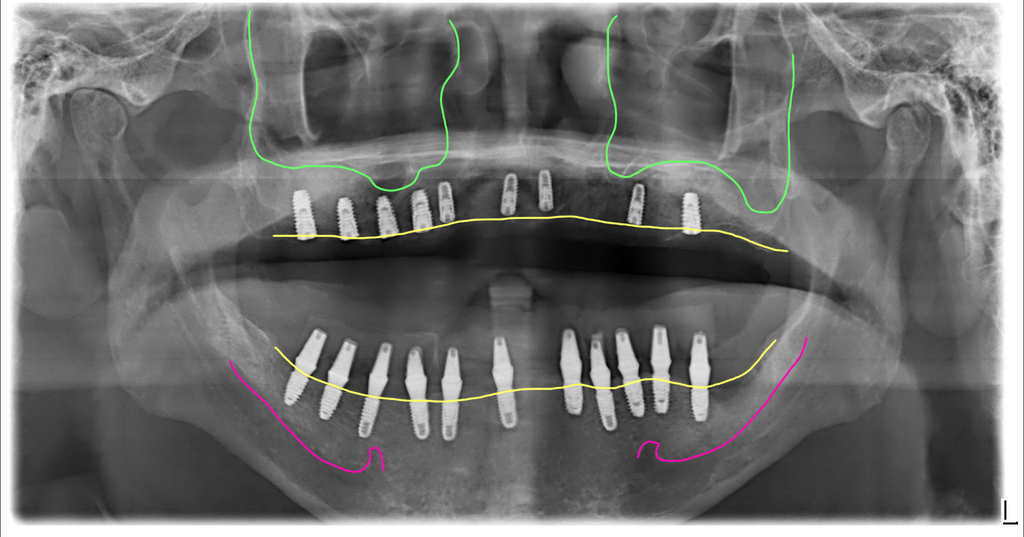
The patient chose upper full-arch implants to coordinate the upper and lower arches, and upper surgery followed.
Five months is the interval from lower to upper surgery, not the complete treatment duration or the final restoration date.
04. Final restorations and long-term record
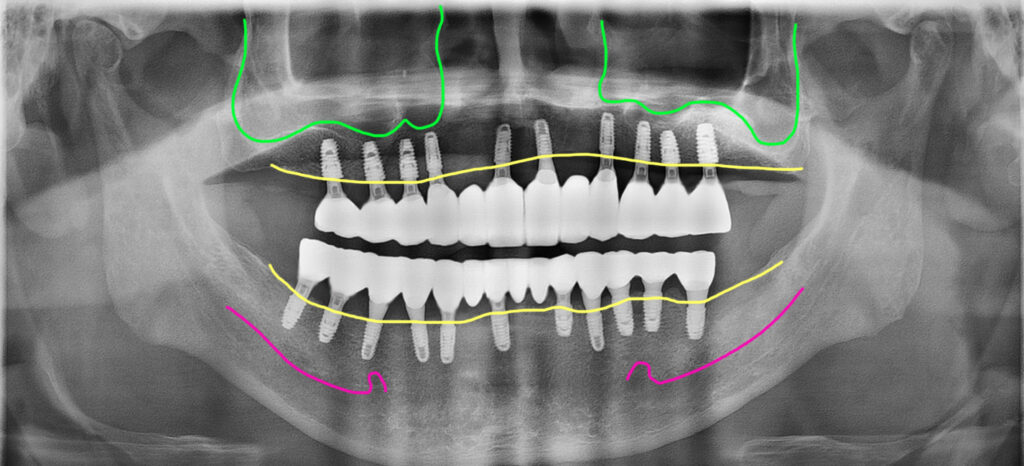
Treatment in both jaws was completed with final crown-and-bridge restorations.
Sixth year of use recorded in the original article
The original article records six years of use without particular problems and regular reviews. This is not a newly confirmed current examination.
Before-and-after CT comparison
With a narrow lower jaw, the original article describes the digital guide as helpful in planning implant positions and surgery.
This is an individual treatment record. Bone, gums, plans and outcomes differ between patients.
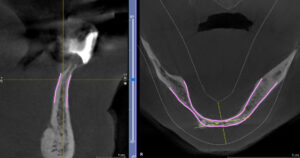
Pretreatment CT · April 7, 2020

Long-term CT · December 15, 2025

Five points to discuss before full-mouth implants
Compare the same treatment scope, restoration structure and included items when reviewing fees.
01 · Implant numbers and restoration design
Ask about implant and final-tooth numbers, connections and materials. Photographs and diagrams can help comparison.
02 · Teeth fitted on surgery day
Ask whether extraction, implant placement and temporary teeth are provided together or in stages. Distinguish temporary teeth from final restorations.
03 · Digital surgical guide
Ask whether a guide is appropriate and how positions and surgery are planned. Not every operation needs a guide.
04 · Included and additional fees
Ask what the total estimate includes and how complexity, grafting, temporary teeth, restorations, guides and sedation affect it.
05 · Clinical experience and aftercare
Ask about similar cases, the operating clinician, follow-up and plans for managing problems.
This is a general consultation checklist, not this patient's actual fees or a statement that each item was charged separately.
Full-mouth implantsFAQ
Yes. The term covers a range of approaches between clinics.
Check implant numbers, restoration structure and materials, same-day temporary teeth and guided surgery carefully.
Estimates vary with implant numbers, restoration design and materials, same-day teeth, grafting, sedation and other components.
When comparing fees, check that the treatment scope is equivalent and identify included and additional items . Ask who performs surgery and how follow-up and complications are managed.
Ask why the treatment is recommended, what alternatives exist, its expected limits and precautions, and the course of similar cases.
Understanding both benefits and limitations, with the review and maintenance plan, helps you understand the proposal.