
FULL-ARCH IMPLANTS · Treatment record
Full-arch implant treatment requires planning not only the surgery, but also the height of the final teeth and how the surrounding gums will be maintained. This patient had been wearing upper and lower dentures and underwent surgery and received temporary teeth on the day of consultation.
We later allowed time to adapt to a revised tooth height and fabricated the restorations in stages because of the mobile lower gum tissues. This case involved seven treatment visits from December 15, 2023 to July 10, 2024. The visits and time required vary with the patient’s condition.
Panoramic radiographs of the same patient before treatment and at completion of the final restorations. Colored lines identify areas to observe; they are not numerical measurements. Pain, swelling, infection, inflammation around implants, restoration fracture or screw loosening can occur after implant treatment, requiring appropriate care and regular review.
01 · A question you may have
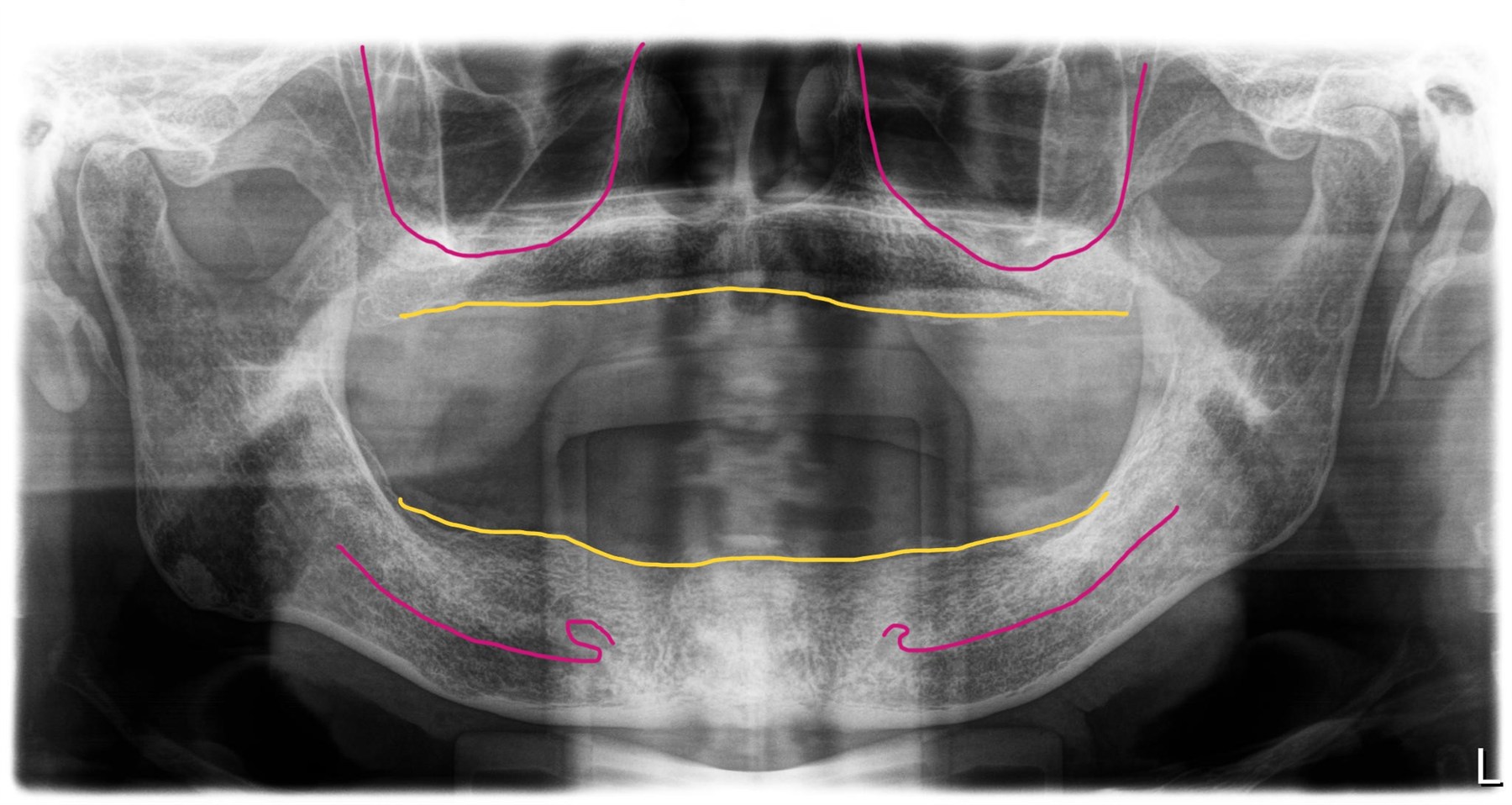
Photographed 2023.12.15
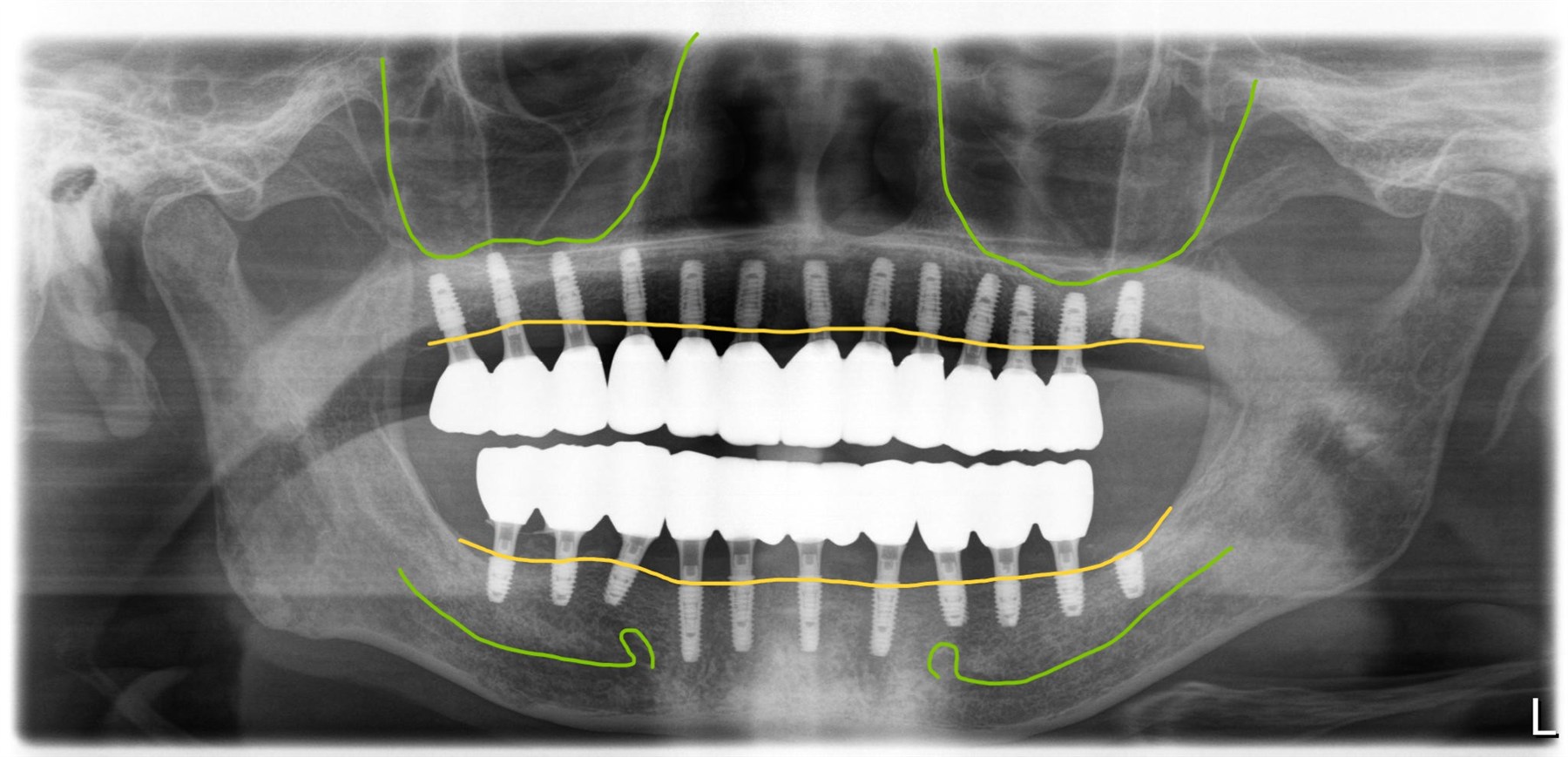
Photographed 2024.07.10
1. Why were seven visits needed if temporary teeth were fitted on the surgery day?
This patient had limited attached gingiva and an unstable bite, requiring seven visits from surgery through completion of the final restorations. Attached gingiva is the gum tissue firmly bound to the tissues beneath it, and the bite describes how the upper and lower teeth meet. Because the lower gums were mobile, scanning and restoration fabrication were performed in stages. The patient also adapted to adjustments in the bite and tooth height while using temporary teeth.
Having teeth on the surgery day does not mean the final restorations are complete. While the patient used temporary teeth, we revised their height to suit the face. Mobile lower tissues also meant digital scanning and fabrication were divided into stages.
We aim to reduce visits while retaining the checks that are necessary. In this case, seven visits were required from surgery to the final restorations.
02 · Initial condition
2. The patient had no upper or lower teeth and was wearing dentures
On December 15, 2023, the patient traveled from Gimhae, Gyeongsangnam-do, for full-arch implant treatment. We took panoramic and CT images and provided a consultation.
The patient did not drink alcohol or smoke, and blood glucose was controlled while taking one diabetes tablet daily. Although the patient was completely without natural teeth in both jaws, examination showed relatively favorable bone quantity and quality.
However, the lower jaw had little firmly attached gum tissue and a large amount of mobile mucosa. Alongside bone condition, we needed to consider a restoration design that would allow effective cleaning around the gums.
03 · Visit 1 / 2023.12.15
3. Surgery and temporary teeth on the consultation day
After examination and consultation, surgery was performed that day. We checked the postoperative condition with a panoramic radiograph and used an oral scan to design the abutments and temporary teeth. An abutment connects an implant to the tooth-shaped restoration.
Upper and lower temporary teeth were fitted after surgery. These were temporary teeth, rather than the final zirconia restorations. We subsequently used them to assess the bite height and harmony with the face.
04 · Visit 2 / 2023.12.29

Photographed 2023.12.15
4. Suture removal and a check two weeks later
The patient returned two weeks after surgery for suture removal and review. The record noted no particular concerns at that visit.
05 · Visit 3 / 2024.03.20
5. Scanning and height adjustment for the final restorations
We scanned the scan bodies to digitally record the implant positions. Considering that the face appeared somewhat long with the temporary teeth in place, we decided to lower the bite height slightly.
Bite height, or vertical dimension, is the height when the upper and lower teeth meet. Tooth height and arrangement can affect the appearance around the mouth and facial proportions, so facial harmony is assessed during full-arch implant treatment.
06 · Visit 4 / 2024.03.21
6. Final upper posterior teeth and testing the other designs
At the next morning’s visit, zirconia final restorations were fitted to the upper posterior teeth. A revised design for the upper front teeth and entire lower arch was made in PMMA, a temporary restorative material.
Rather than immediately making every restoration final after changing the height, we first checked adaptation to the revised height.
07 · Visit 5 / 2024.06.20
7. Preparing final restorations at the revised height
We took impressions for the final restorations using the bite height adjusted at the previous visit. Experience with the temporary teeth helped determine the final height and contours.
08 · Visit 6 / 2024.07.01
8. Completing the front teeth and scanning the lower posterior regions
After fitting zirconia final restorations to the upper and lower front teeth, we took impressions for the final lower posterior restorations.
There was a reason for staging this process. A large amount of mobile soft tissue in the lower jaw made a single full-arch digital scan difficult. We therefore set the front teeth first, then scanned the lower posterior regions separately.
09 · Visit 7 / 2024.07.10
9. Completing the final lower posterior restorations
Finally, zirconia restorations were fitted to the lower posterior teeth, completing the final restorations in both arches. The after-treatment panoramic radiograph near the top was taken that day.
The patient’s full-arch implant treatment was completed in seven visits in total. I appreciate the effort involved in traveling a long distance for treatment.
10 · What mattered in this case
10. Favorable bone still requires attention to the gums and bite height
Although bone condition was favorable, the lower gum tissues were highly mobile. The restorations needed a design that supported hygiene, and staged scanning and fabrication increased the number of visits.
For suitable patients, Harue Dental may plan full-arch implant treatment around a basic four-visit process. The same number does not apply to everyone. Bite-height adjustment, adaptation checks and scanning conditions can require additional visits.
This record covers treatment through completion of the final restorations on July 10, 2024.
11 · Aftercare
11. What do we check at six-month reviews?
This patient was advised to return for regular checks every six months. At reviews, we assess:
- Whether implant restorations are loose
- Inflammation around implants
- The effectiveness of cleaning
- The condition of resin sealing the screw-access holes
- Open spaces or areas where food becomes trapped
- How well the upper and lower teeth meet—the bite
- Movement of the gum tissues around implants
Brushing and cleaning beneath the restorations are taught according to the patient’s condition. Reviews may need to be more frequent depending on gum health and hygiene. Looseness, pain or swelling should be checked without waiting for the scheduled visit.
12. Frequently asked questions about full-arch implant treatment
Can a denture wearer have implant surgery on the consultation day?
In this case, surgery was possible after examination and consultation that day. The decision depends on bone, gums, general health, surgical planning and the patient’s consent. Same-day surgery is not possible for every patient.
Can the height be changed after temporary teeth are fitted?
Yes. We reviewed this patient’s facial appearance and restoration height while using temporary teeth, then reduced the vertical dimension. We checked adaptation to the new height and reflected it in the final restorations.
How many visits are needed for full-arch implants?
It depends on the findings and restoration process. This patient needed seven visits because height adjustment and staged fabrication followed the same-day temporary teeth. The individual schedule is explained after diagnosis.
Are full-arch implants the only option if all teeth are missing?
Conventional dentures and implant-retained dentures may also be considered. Bone and gums, ability to maintain hygiene, treatment goals and cost all help determine the choice.
13. Full-arch implant planning and maintenance
We plan appointments together to reduce the travel burden for patients coming from far away while retaining necessary treatment visits.