
HARUE · Discoloration after front-tooth root canal treatment and restorative retreatment
Front-tooth root canal treatment should address infection and consider discoloration prevention. Sealers, tissue left in the pulp chamber, and dark posts or cores may contribute. Restoring color can become more complex once severe staining has developed.
Before and after front-tooth restorative retreatment
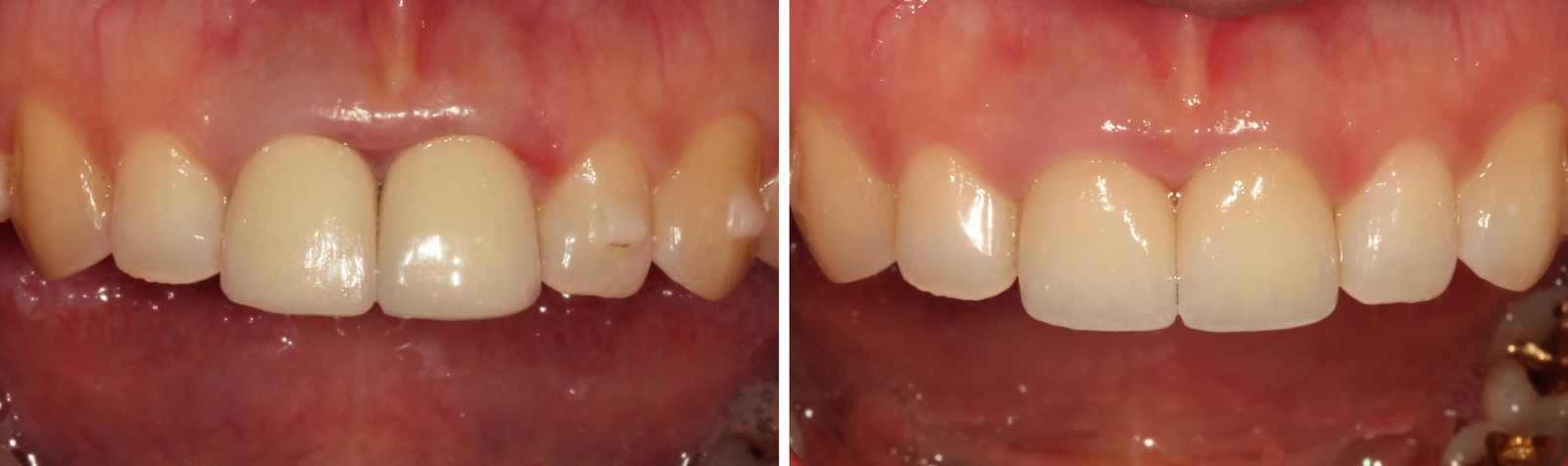
Actual records of the same patient. Different angles and lighting may affect perceived color. Select an image to enlarge it. A one-week result does not represent long-term maintenance.
Why severe discoloration may follow front-tooth root canal treatment
Not all root-treated front teeth turn black. Previous trauma, internal bleeding, residual tissue and treatment or restorative materials may contribute. These are general explanations; a metallic post and a dark core are visible in this case.
Sealer discoloration and material remaining in the pulp chamber
Sealer is used to fill and seal the root canal. Its composition, position and the amount left in the pulp chamber may affect color. Laboratory studies leaving sealer residues have also observed tooth discoloration.
Study of sealer residues and tooth color · This does not establish patient-specific incidence.
Pulp tissue or blood remaining in the crown
Residual pulp tissue in narrow areas such as pulp horns, or blood components, may contribute to later discoloration. Root canal treatment therefore requires attention to tissues and residues in the pulp chamber as well as the canals.
Metal posts and dark cores such as amalgam
Posts help retain restorations supporting a crown; cores rebuild the upper part of the tooth. Metal posts and dark cores may show through, or their components may stain surrounding tooth tissue.
A dark appearance may reflect both material showing through and staining within tooth tissue, which need to be distinguished clinically.
Discoloration extending toward the neck or root
If staining extends toward the cervical or root area, it may appear near the gum or through thin gum tissue. Root color and gum thickness influence aesthetic planning.
These photographs alone cannot establish the extent or cause of discoloration throughout the root.
Residual tissue, restorative materials and planning for root color: Managing discoloured teeth (International Endodontic Journal, 2022)
In this case, I restored both the outer crowns and internal posts
This 2012 record concerns retreatment of the two upper central incisors. The comparisons show the internal foundation and the appearance one week after crown placement.
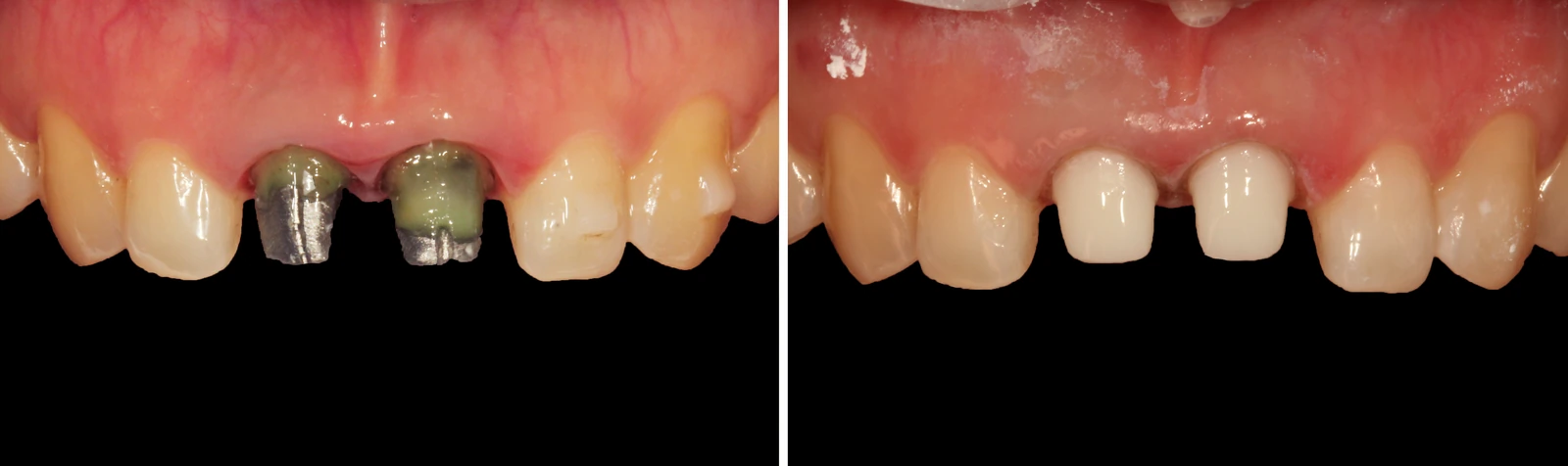
From metallic posts to tooth-colored posts
I removed the metallic posts and cores beneath the old crowns and restored the teeth using e.max posts. The right image is before the final crowns were placed.
Recording the inner margins as well
Alongside the front view, we recorded the inner boundaries between restoration and tooth. These images compare pretreatment with one week after crown placement.
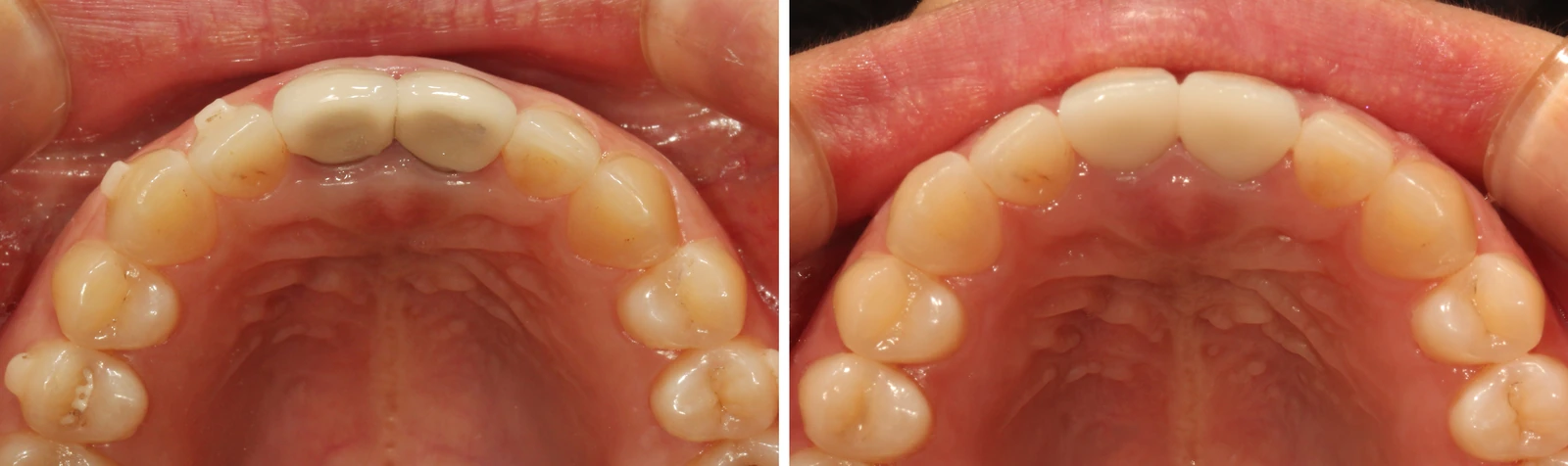
e.max posts + VITABLOCS crowns
On July 3, 2012, after restoration with e.max posts, VITABLOCS crowns were completed with CEREC on the same day. A one-week review was photographed on July 10.
Same-day completion describes this patient’s treatment then. The same schedule does not apply to every front-tooth retreatment.
Zirconia posts are now used in similar cases
Harue Dental currently uses zirconia posts in similar cases. The posts in this 2012 case were e.max and should be distinguished from the materials used today.
Changing to a tooth-colored material does not automatically restore the original color of stained tissue. Whether to retain or replace a post and which material to use depend on the remaining tooth and root.
Why can a discolored front tooth be difficult to retreat?
Protecting remaining tooth tissue as well as addressing color
Longstanding, deep staining can be difficult to reverse. We assess the background beneath restorations, gums and roots, and consider the risk of damaging remaining tissue during post removal.
Metal posts are not removed simply because they are metal. This case’s treatment is not applied unchanged to everyone.
Considering internal bleaching, restoration and observation
Internal bleaching may improve color in selected teeth; replacement restorations or crowns may also be considered. Discoloration is not always irreversible, but achieving the desired shade may require several steps and darkening can recur.
Internal bleaching carries risks including root resorption and requires assessment. This does not mean it was performed in this case.
Interdental cleaning and regular checks remain necessary. Seek care for restoration fracture or debonding, pain or gum changes. These photographs extend only to one week after placement and do not guarantee lasting color stability or restoration lifespan.
Four points to discuss before front-tooth root canal treatment
Planning to reduce discoloration risk from the beginning matters. Alongside infection control and sealing, ask about aesthetic considerations.
Is a sealer with lower discoloration risk considered?
Products differ in composition and staining potential. Color stability matters for front teeth. Some newer materials replace staining-related components, but no product or material group can be guaranteed never to discolor under all conditions.
AAE · Endodontic materials and discoloration-related components
Are tissues, blood and material residues cleared from the chamber?
Materials alone are not enough. Managing unnecessary tissue and sealer residues in the crown is important. A long-term laboratory study also emphasized thorough removal of chamber sealer.
Are post, core and final restoration planned together?
We assess whether a post is necessary, how much tissue can be preserved, and how the background may affect the restoration and gum appearance. Post color alone does not determine suitability.
Is there a plan for the coronal seal and follow-up?
The upper part of the tooth should be appropriately restored after root canal treatment, with later checks of margins, teeth and gums. Baseline photographs and color records help comparisons.
Discoloration after front-tooth root canal treatment: FAQ
Must a root-treated front tooth turn dark?
No. Trauma, bleeding, residues and materials may contribute. Careful planning may reduce risk, but complete prevention of every discoloration cannot be guaranteed.
Is there a sealer that never discolors?
Some products are designed for lower risk and color stability. Laboratory and clinical conditions differ, and tissue, blood and restorations also influence color. Discuss the choice and residue management rather than relying on a material name as a guarantee.
Does a tooth-colored post solve all discoloration?
It may reduce show-through from a dark post, but does not automatically reverse stained tooth or root tissue. Examination guides a combination of bleaching or restorative options where appropriate.
Is a black crown margin the same as discoloration after root canal treatment?
Metal or background showing through at a restoration margin differs from staining of the tooth itself. Gums also affect appearance, so darkness alone does not establish the cause.
Was this a same-day zirconia treatment?
The 2012 case used e.max posts and VITABLOCS crowns, completed with CEREC that day. This differs from the zirconia posts currently used for similar cases.
Discuss discoloration prevention before front-tooth root canal treatment
If a tooth has already darkened, first assess the cause, depth and remaining tissue.
For a first treatment, discuss infection control, materials, residue management and the final restoration.
References
- Sealer residues and tooth color — laboratory study
- Crown discoloration caused by root canal sealers — three-year laboratory study
- Kahler, Managing discoloured teeth (2022) — review of causes and treatment options
- American Association of Endodontists — Bioceramic Usage in Endodontics
These sources support general explanations, not the specific cause or outcome of this patient’s treatment.
How much does this treatment cost?
Fees vary with materials, extent and tooth condition.
The full plan and cost, including post retreatment where required, are explained after diagnosis.
The fees page shows current standard fees,
not the amount paid by this patient.