
Full-mouth Implant Rehabilitation with Natural Teeth Preserved
A Six-year Follow-up
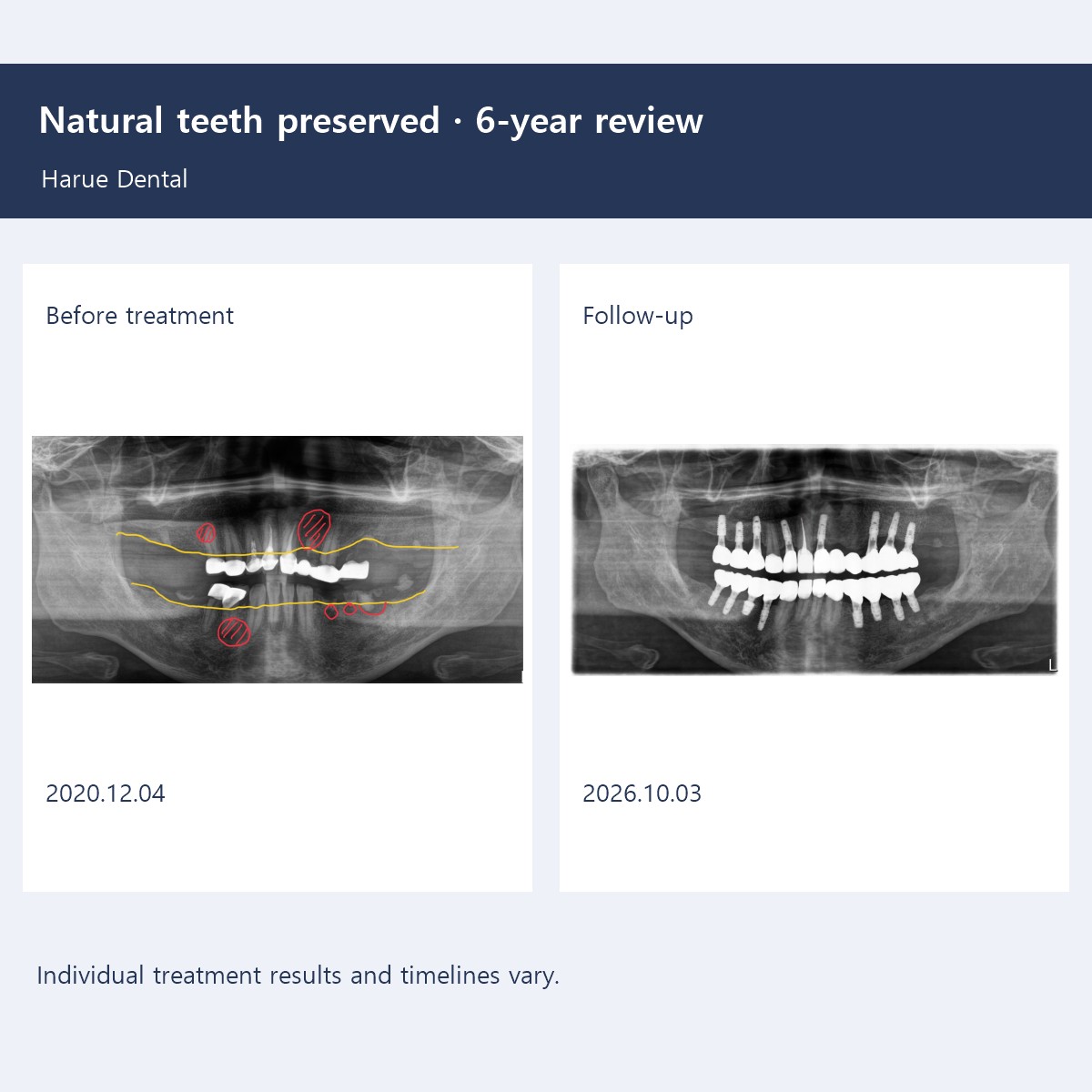
CASE SUMMARY · Full-mouth rehabilitation preserving natural teeth
Case at a glance
Initial consultation in 2020
Old connected restorations and multiple missing molars
Natural teeth suitable for preservation identified
Eight upper · Eight lower implants
After blood-pressure control, upper-jaw surgery under sedation on day one and lower-jaw surgery the following day
Six years after treatment
Clinical assessment found the implants and restorations maintained without alveolar bone loss
Surgery was divided over two days. This does not mean all treatment, including the final restorations, was completed in two days.
Treatment and review of the Korean source: DR. Hanna Lee
If several restorations are old and many molars are missing, must all remaining teeth be extracted?
In this case, each tooth was assessed for preservation, usable natural teeth were retained and implants placed where needed. Full-mouth treatment combined retreatment of old restorations with replacement of multiple missing teeth.
01. A comprehensive treatment plan
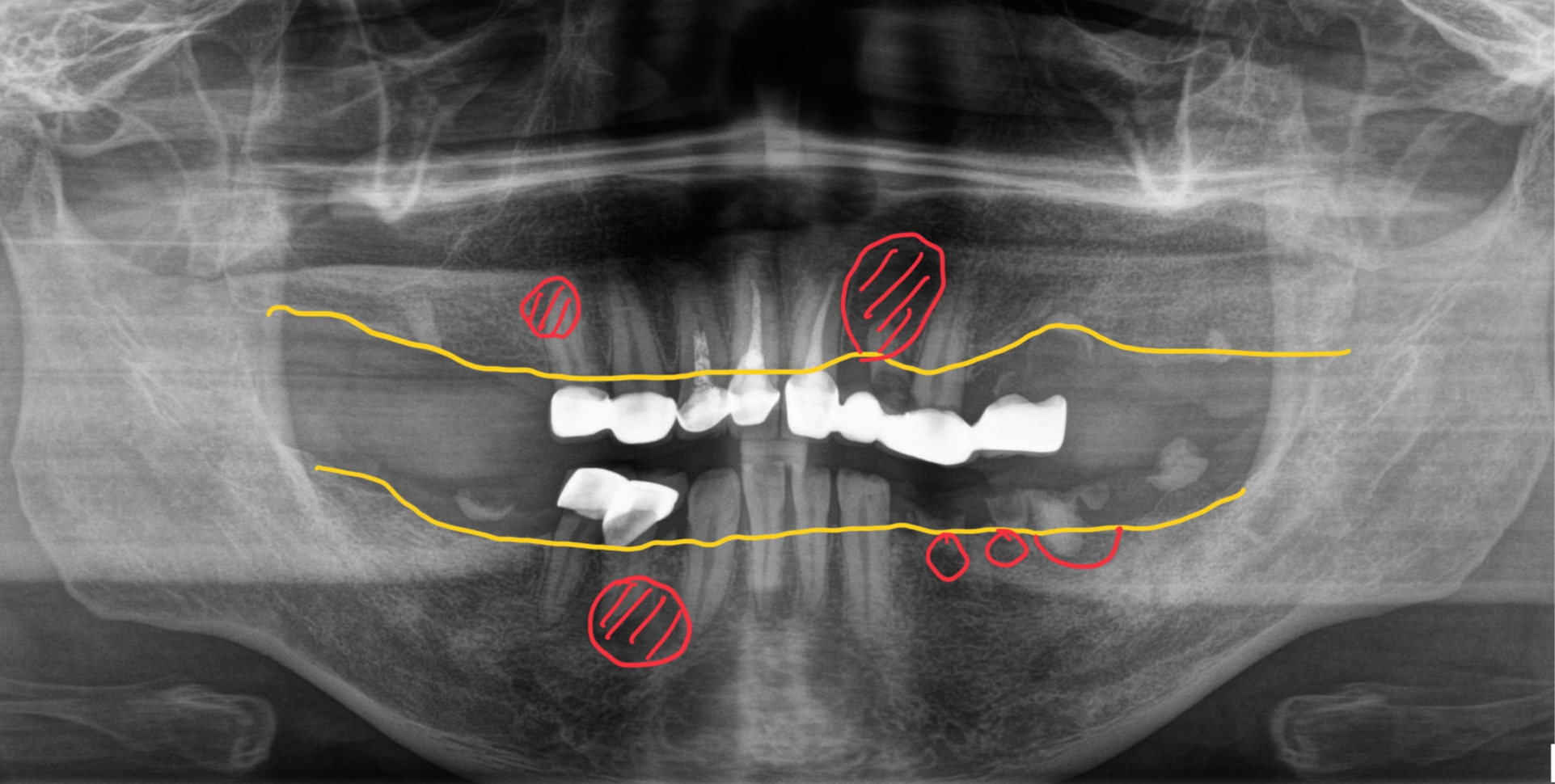
Photographed: December 4, 2020
The patient came in saying, “I think the teeth beneath my old dental work are decayed.” Concerned about extensive treatment, the patient initially wanted to start on the right side and requested sedation because of severe dental anxiety.
Examination showed that treatment was not limited to the right side. The upper jaw had old connected restorations, several back teeth were missing on both sides, and remaining teeth varied in their prospects for preservation and ability to support new restorations.
We therefore needed to assess the remaining teeth, existing restorations and missing areas together to establish an overall plan.
02. Identifying natural teeth that could be preserved
“Full-mouth” here means considering and treating the dentition across both jaws. It does not mean that every natural tooth was extracted and replaced with an implant.
Each tooth was evaluated for periodontal support, root condition, the condition beneath existing restorations and usefulness after new restorative treatment.
The plan favored preserving natural teeth judged likely to remain usable for more than five years after treatment. This was an individual clinical prognosis, not a guarantee of a fixed lifespan.
Teeth judged difficult to preserve or unfavorable to long-term overall stability were selected for extraction. Treatment began by distinguishing teeth that could be retained from those requiring extraction.
03. Distinguishing extractions from pre-existing missing teeth
The numbers below use the international FDI tooth-numbering system.
| Category | Tooth numbers |
|---|---|
| Extracted in the upper jaw | #14, #12, #21, #22, #23 |
| Extracted in the lower jaw | #44, #45 |
| Lower front teeth already missing before treatment | #32, #42 |
Lower front teeth #32 and #42 were not extracted during this treatment. They were already missing and should be distinguished when comparing before-and-after images.
04. Eight implants in each jaw
Implant positions reflected the locations and condition of remaining natural teeth and the restoration plan.
Eight upper implants:
#16 · #15 · #14 · #12 · #21 · #24 · #25 · #26
Eight lower implants:
#34 · #35 · #36 · #37 · #44 · #45 · #46 · #47
The implants extended to the first-molar positions (6) on both sides of the upper jaw and to the second-molar positions (7) on both sides of the lower jaw. This describes implant locations; actual contact is assessed separately in relation to opposing teeth and restoration shape.
Planning harmonious function between the preserved teeth and implant restorations was an important part of this full-mouth reconstruction.
05. Sedation surgery divided over two days
Blood pressure was high at the first visit, so it was controlled before surgery. Severe dental anxiety also led to treatment under sedation.
The planned upper-jaw surgery was performed under sedation on the first day, followed by the planned lower-jaw surgery under sedation the next day. The procedures were separated with the patient’s general health and treatment burden in mind.
The two days refer to the surgical schedule for both jaws. They do not mean that all treatment, including the final restorations, was completed in two days.
06. Six-year follow-up
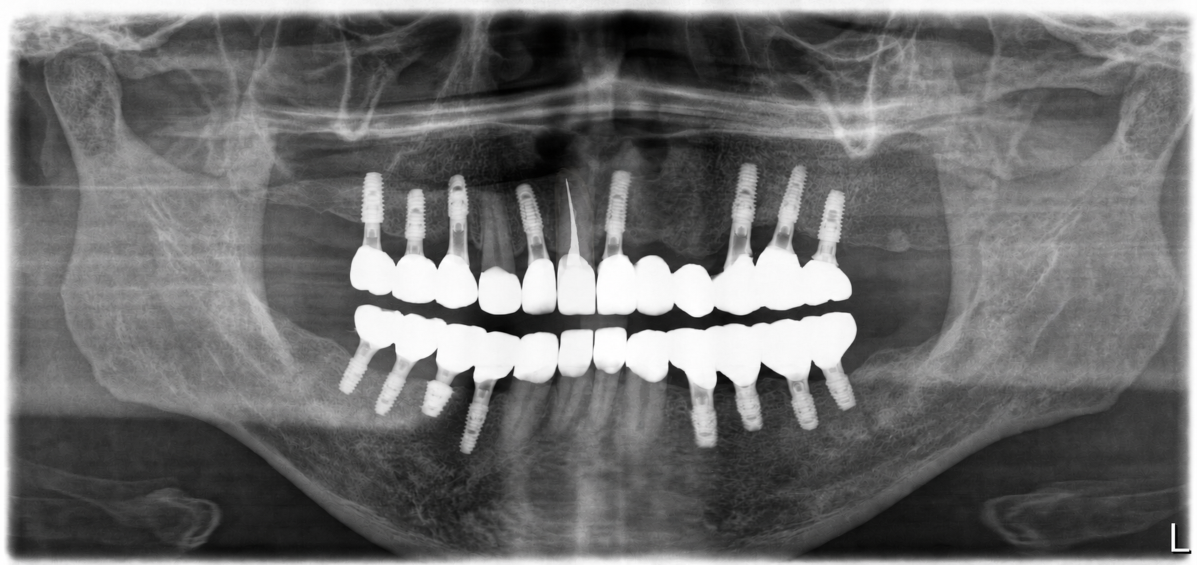
Photographed: October 3, 2026
The panoramic X-ray and follow-up assessment six years after treatment confirmed that the implants and restorations remained in place without alveolar bone loss.
This case restored missing areas with eight implants in each jaw while preserving suitable natural teeth. It is meaningful to document maintenance at six years as well as the immediate result.
Regular reviews of retained teeth, peri-implant tissues, restorations and the bite remain important. This is one patient’s outcome and does not guarantee the same result for everyone.
Full-mouth Implant TreatmentLocation and Opening Hours
Frequently asked questions
Must all natural teeth be extracted for full-mouth implant treatment?
Not necessarily. If natural teeth can be preserved, treatment can retain them while placing implants where needed. Each tooth is judged from periodontal and root condition together with the restoration plan.
Does full-mouth treatment always require 16 implants?
No. This case used eight in each jaw, but the required number and positions depend on remaining teeth, bone condition and the restoration plan.
Must all old restorations be replaced?
Age alone is not a reason to replace every restoration. The underlying teeth, fit, surrounding tissues and bite are examined before deciding what can stay and what needs retreatment.
Are regular checkups still necessary after treatment?
Yes. Preserved teeth and restorations need care alongside the implants. Reviews assess hygiene, surrounding tissues, restorations and the bite, with intervals set individually.